The Battles of Trenton and Princeton were a series of American victories fought in New Jersey between December 26th, 1776, and January 3rd, 1777, during the American Revolutionary War. Led by General George Washington, the Continental Army crossed the Delaware River in the dead of winter and launched surprise attacks on British and Hessian forces. The victories came at a moment when American morale had reached its lowest point of the war, and they transformed the entire outlook of the conflict. They are widely regarded as the turning point that kept the Revolution alive.
What Was the American Revolution?
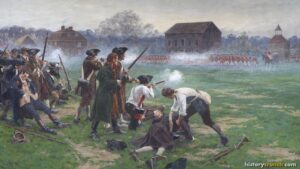
The American Revolution was the political and military struggle through which the Thirteen Colonies broke free from British rule and established the United States of America. Open fighting began in April of 1775 at Lexington and Concord, and the colonies declared independence on July 4th, 1776. By the autumn of that year, however, the Continental Army had suffered a series of devastating defeats, and many observers believed the Revolution might not survive. The victories at Trenton and Princeton reversed that collapse and gave the American cause the momentum it needed to continue.
Background – A Desperate Situation in 1776
Through the summer and autumn of 1776, the Continental Army endured one defeat after another. British forces under General William Howe drove Washington’s army out of New York, capturing Long Island and Manhattan and forcing a long retreat south through New Jersey. In November of 1776, the British overran Fort Washington on Manhattan Island, capturing nearly 3,000 American soldiers. Washington’s second-in-command, General Charles Lee, was captured in mid-December. The army that reached the western bank of the Delaware River in Pennsylvania was a shadow of what it had been. Desertions had reduced its strength to roughly 3,000 men, many without adequate shoes, coats, or supplies, with thousands more enlistments set to expire on December 31st.
Washington himself wrote privately in December of 1776 that he thought “the game is pretty near up.” Thomas Paine, who was with the army during the retreat, wrote the first of his American Crisis pamphlets, which began with the famous line “These are the times that try men’s souls.” Washington had the pamphlet read aloud to his troops to steady their resolve. He knew that if he did not act decisively before the year ended and the enlistments ran out, the army would dissolve.
On the British side, General Howe settled his forces into winter quarters, placing a chain of garrison posts across New Jersey. He stationed approximately 1,400 Hessian soldiers, professional German troops fighting in British service, at the town of Trenton, under the command of Colonel Johann Rall. Rall was an experienced soldier who had little respect for the fighting ability of the Americans. Though warned multiple times that an attack might be coming, he did little to fortify the garrison.
The Crossing of the Delaware
Washington devised a bold plan to cross the Delaware River on the night of December 25th and attack the Hessian garrison at Trenton before dawn. The crossing was planned for three separate points on the river, but ice floes and a fierce winter storm made conditions treacherous. In the end, only Washington’s main force of approximately 2,400 men successfully completed the crossing. Two other detachments were turned back by the conditions. The men crossed through the night in flat-bottomed Durham boats, guided by experienced boatmen from the Massachusetts Marblehead regiment under Colonel John Glover. By the early hours of December 26th, the army was across. It took several more hours to get 18 cannon across the ice-filled river before the march to Trenton could begin.
Washington divided his force into two columns for the final approach. The left column under General Nathanael Greene would approach from the north, while the right column under General John Sullivan advanced from the south, cutting off any escape routes. The attack began around eight in the morning on December 26th, 1776.
The Battle of Trenton
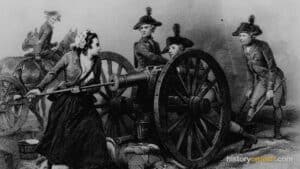
The Hessians were caught almost completely off guard. Colonel Rall had been at a Christmas party the night before and was still in his quarters when the attack began. Within minutes, American artillery controlled the main streets of the town, and the Hessian forces were thrown into confusion. Rall attempted to organize his men for a counterattack but was mortally wounded in the fighting and died later that day. The battle lasted approximately 45 minutes.
The result was a stunning American victory. Nearly 900 Hessian soldiers were captured, along with weapons, ammunition, food, clothing, and supplies that the Continental Army desperately needed. American casualties were remarkably light, with no soldiers killed in battle, though two men froze to death during the night crossing. Washington withdrew his force back across the Delaware into Pennsylvania that same day, bringing his prisoners and captured supplies with him.
The Second Crossing and the Battle of Assunpink Creek
Emboldened by the victory at Trenton, Washington decided to press his advantage before the year-end expiration of his soldiers’ enlistments. He crossed back into New Jersey on December 30th, 1776, and established a position at Trenton. On January 2nd, 1777, British General Lord Cornwallis marched south from Princeton with approximately 7,000 troops to confront Washington. American skirmishers slowed the British advance considerably, delaying what should have been a three-hour march into most of the day.
By the time Cornwallis reached Trenton, Washington’s army had taken up a strong defensive position south of Assunpink Creek. The British launched several attacks across the creek and were repulsed each time. Cornwallis, believing Washington was trapped with the Delaware River behind him and his own army blocking the front, decided to wait until morning to deliver a final blow. “We’ve got the old fox now,” he reportedly said. “We’ll go over and bag him in the morning.” That night, Washington made one of the boldest decisions of the war.
The Battle of Princeton
With his campfires still burning to deceive the British into thinking the army was in place, Washington quietly moved his entire force out of their positions during the night of January 2nd, leaving by a back road that circled around Cornwallis’s army. The 12-mile (19-km) march through the frozen darkness was punishing but successful. By dawn on January 3rd, the Continental Army was approaching Princeton, 10 miles (16 km) behind the British lines.
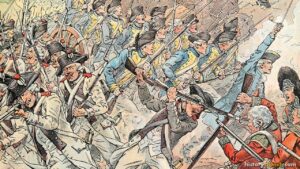
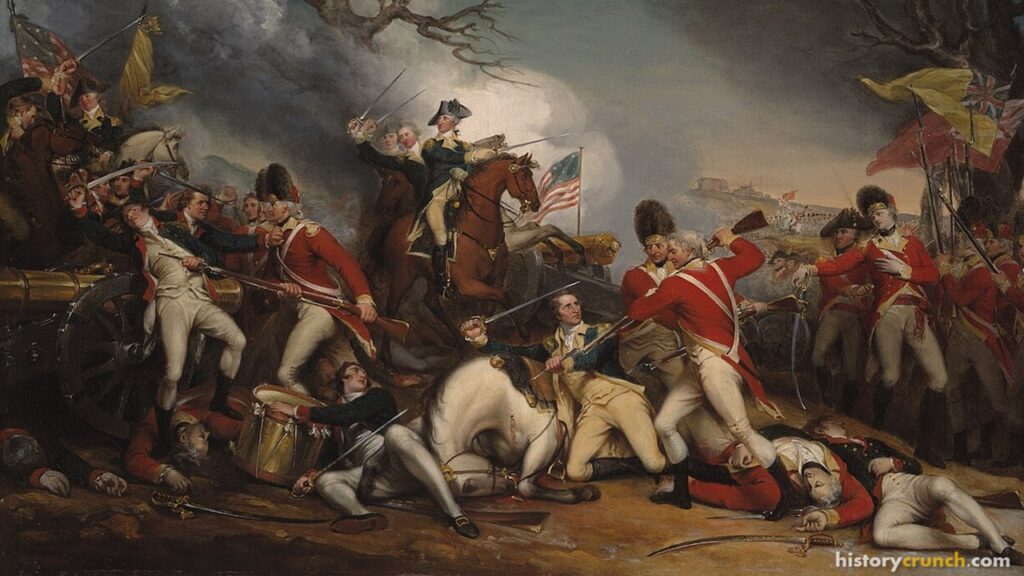
Washington’s advance force under General Hugh Mercer stumbled into two British regiments under Lieutenant Colonel Charles Mawhood, who had been marching south from Princeton toward Trenton to reinforce Cornwallis. A fierce skirmish broke out. Mercer was surrounded, unhorsed, and stabbed multiple times with bayonets after refusing to surrender. He died of his wounds nine days later. When militia units coming up behind Mercer began to falter, Washington himself rode forward between the firing lines, rallying his men under direct fire. The Americans broke through Mawhood’s lines, driving the British back toward Princeton.
British soldiers who had taken shelter in Nassau Hall at Princeton College surrendered when American artillery under Captain Alexander Hamilton opened fire on the building. Washington wanted to push further north to attack the main British supply depot at New Brunswick, but his officers persuaded him that the army was too exhausted to continue. Instead, the Continental Army marched to Morristown, New Jersey, where it went into winter quarters on January 6th, 1777. With the British now outflanked and their supply lines threatened, Cornwallis abandoned Trenton and pulled back to New Brunswick, effectively surrendering control of most of New Jersey.
Significance of the Battles of Trenton and Princeton
The significance of the Battles of Trenton and Princeton cannot be overstated. Coming after months of demoralizing retreat and defeat, these victories demonstrated that the Continental Army could fight, win, and outmaneuver a professional European military force. They restored confidence in Washington as a commander, inspired thousands of new enlistments in the spring of 1777, and convinced many wavering colonists that the Revolution had a real chance of success.
They also had important international consequences. Word of the American victories traveled to Europe, where France was watching the war closely. The ability of the Continental Army to survive and win under such desperate conditions strengthened the case of those in France arguing for an American alliance, which would eventually be formalized in 1778. Washington’s daring ten-day campaign across the Delaware in the middle of winter remains one of the most celebrated episodes in American military history and a defining moment in the story of the United States.