The First Battle of Bull Run was the first major land battle of the American Civil War and one of the most significant events of the conflict’s opening year. Taking place on July 21st, 1861, near the town of Manassas in Virginia, roughly 25 miles southwest of Washington D.C., the battle shattered the widespread belief that the Civil War would be a short and easy conflict. A Confederate victory, the First Battle of Bull Run shocked the Union and forced both sides to recognize that the war would be long, bloody, and far more serious than anyone had anticipated.
What Was the American Civil War?
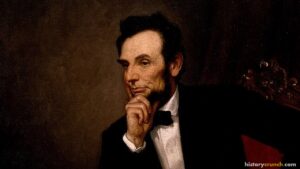
The First Battle of Bull Run took place during the early months of the American Civil War, which was one of the most devastating conflicts in the history of the United States. The Civil War was fought between the Northern states, known as the Union, and the Southern states, known as the Confederacy, from 1861 to 1865. At its heart, the war was driven by the issue of slavery, which had divided the country for decades. Following the election of President Abraham Lincoln in November of 1860, several Southern states seceded from the Union and formed the Confederacy. The war officially began on April 12th, 1861, when Confederate forces bombarded the Union garrison at Fort Sumter in Charleston Harbor, South Carolina. After the fall of Fort Sumter, Lincoln called for 75,000 volunteer soldiers and both sides began preparing for war. Most people in the North and the South expected the conflict to be brief, with many believing it would be over within a matter of months. The First Battle of Bull Run would prove them dramatically wrong.
First Battle of Bull Run – Background and Causes
Following the fall of Fort Sumter, public pressure in the North mounted quickly for the Union army to take decisive action against the Confederacy. Newspapers ran headlines demanding an advance on Richmond, Virginia, which had become the capital of the Confederacy in May of 1861. The rallying cry across the North became “On to Richmond.” Responding to this pressure, President Lincoln ordered General Irvin McDowell to lead the Union army southward into Virginia and engage the Confederate forces stationed near Manassas Junction, a vital railroad hub roughly 25 miles southwest of Washington D.C. The Confederate forces there were commanded by General P.G.T. Beauregard, the same officer who had overseen the bombardment of Fort Sumter. Beauregard’s army at Manassas numbered approximately 22,000 soldiers.
McDowell was a cautious man and was reluctant to advance. He knew his army of approximately 35,000 troops was largely made up of inexperienced volunteers who had enlisted for only 90 days and lacked proper training and discipline. He argued that his troops needed more time before taking on the Confederates. Lincoln acknowledged his concerns but pointed out that the Confederate army was equally untrained and ordered McDowell to advance. The delays involved in these discussions, however, gave Beauregard valuable time. A second Confederate force of approximately 10,000 soldiers under General Joseph Johnston was stationed in the Shenandoah Valley to the west. The Union plan called for a separate force under General Robert Patterson to keep Johnston pinned down in the valley and prevent him from joining Beauregard. Patterson failed to do so, and Johnston’s troops boarded trains and arrived at Manassas Junction, bringing Confederate strength to roughly 32,000. It was one of the first times in history that a railroad had been used to move troops to a battlefield during wartime.
First Battle of Bull Run – Major Events
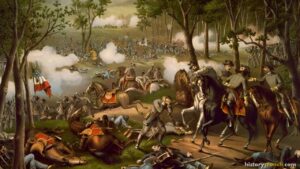
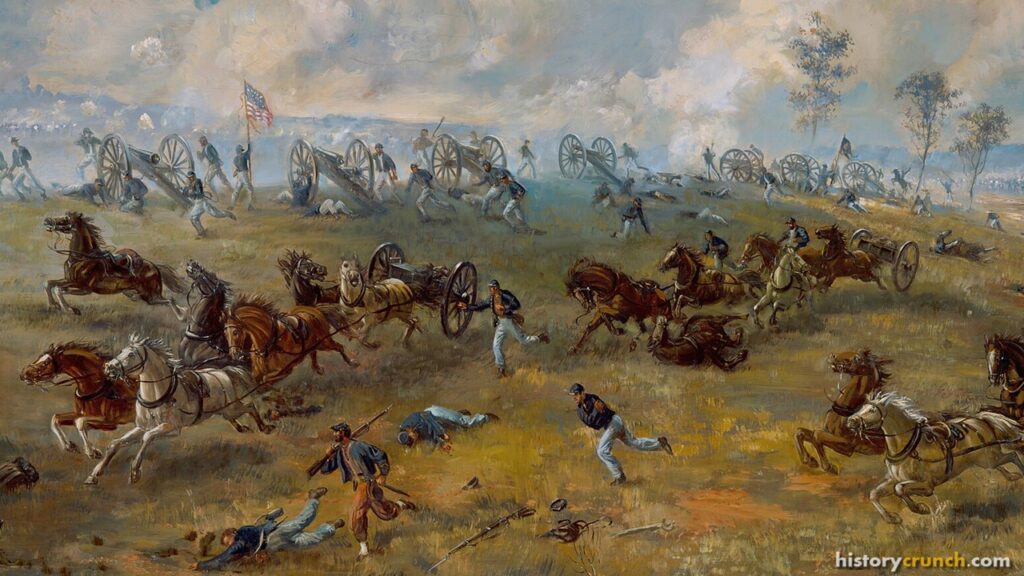
On the morning of July 21st, 1861, McDowell launched his attack. His plan involved sending a large flanking force around the Confederate left to strike from an unexpected direction while a smaller force created a diversion at a stone bridge along the Confederate line. Both sides committed around 18,000 troops to the actual fighting. McDowell’s flanking force crossed Bull Run at Sudley Ford and pushed southward, driving Confederate forces back from a position known as Matthews Hill toward Henry House Hill. For a time it appeared that the Union might win a relatively quick victory. Spectators from Washington, including members of Congress and ordinary citizens, had traveled out to the Virginia countryside to watch what many expected would be a thrilling Union triumph. They brought picnic baskets and gathered on hillsides overlooking the battlefield.
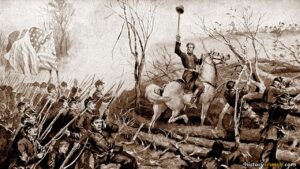
The Confederate forces stiffened their resistance at Henry House Hill. A Virginia brigade commanded by General Thomas Jackson held its position so firmly under the Union assault that a fellow Confederate general reportedly called out that Jackson was standing like a stone wall, earning him the famous nickname ‘Stonewall’ Jackson. The Union attacks on Henry House Hill were repeatedly repulsed through the afternoon. As the fighting intensified, the last of Johnston’s reinforcements arrived from the Shenandoah Valley by train and joined the battle at a critical moment. Boosted by the fresh troops, Confederate forces launched a vigorous counterattack that broke the exhausted Union lines.
What started as an orderly Union withdrawal quickly collapsed into a full rout. Panicked soldiers broke and ran toward Washington. The retreat turned chaotic as fleeing troops became mixed up with the civilian spectators who were now desperate to escape. Wagons, horses, and people choked the roads back to Washington in scenes of complete disorder. Although the Confederates had won a clear victory, their own forces were too exhausted and disorganized to mount an effective pursuit, and the retreating Union army made it back to Washington.
First Battle of Bull Run – Aftermath
The battle resulted in approximately 2,896 Union casualties and 1,982 Confederate casualties, figures that shocked people on both sides who had expected a quick and relatively bloodless conflict. The defeat sent shockwaves through the North and the vulnerability of Washington D.C. was suddenly very real. In the days that followed, Lincoln called for 500,000 additional volunteers and Congress passed legislation extending the length of military enlistment, making clear that the war would require a far greater commitment than anyone had initially imagined. Lincoln also replaced McDowell with General George B. McClellan, who was tasked with rebuilding and reorganizing the demoralized force into what would become the Army of the Potomac.
In the South, the victory at Bull Run produced an outpouring of celebration and confidence. Many Confederates took the result as proof that their soldiers were superior fighters and that the North lacked the will to sustain a long war. Historians have since noted that this overconfidence would prove costly in the months and years ahead.
Significance of the First Battle of Bull Run
The First Battle of Bull Run was one of the most significant events of the American Civil War. Its greatest importance was not military but psychological. The battle destroyed the illusion on both sides that the war would be brief and relatively painless. In the North it created a sense of shock and urgency that led to a massive expansion of the Union war effort and a new seriousness about the scale of the conflict ahead. In the South it produced a dangerous overconfidence that needed to be tempered by the hard fighting that followed. The battle also introduced the world to Stonewall Jackson, who would become one of the most celebrated military commanders of the entire war. Most importantly, the First Battle of Bull Run made clear to both the Union and the Confederacy that the American Civil War would be a long and terrible struggle, not the brief adventure either side had imagined when the first shots were fired at Fort Sumter just three months earlier.