The Battle of Appomattox Court House was the final major battle of the American Civil War in Virginia and one of the most significant events in American history. It took place on April 9th, 1865, near the small village of Appomattox Court House in Virginia, and ended with Confederate General Robert E. Lee surrendering his Army of Northern Virginia to Union General Ulysses S. Grant. The surrender effectively ended the Civil War in the Eastern Theater and set the stage for the end of the entire conflict.
What Was the American Civil War?
The Battle of Appomattox Court House took place during the final days of the American Civil War, which was one of the most significant conflicts in the history of the United States. The Civil War was fought between the Northern states, known as the Union, and the Southern states, known as the Confederacy, from 1861 to 1865. The war was mainly fought over the issue of slavery, which had divided the country for many years. By the spring of 1865, the Confederacy was close to defeat. Grant had spent nine and a half months besieging Petersburg and Richmond, and Lee’s army had been reduced from approximately 60,000 soldiers to fewer than 30,000 through casualties, starvation, and desertion. When Grant finally broke through the Confederate defensive lines at Petersburg in early April, Lee had no choice but to abandon both Petersburg and Richmond and try to escape with what remained of his army.
Battle of Appomattox Court House – Major Events
After the Confederate lines at Petersburg were broken on April 2nd, 1865, Lee evacuated his army overnight and headed west. His plan was to march to Amelia Court House, where he expected to find food and supplies waiting for his soldiers, and then turn south to join General Joseph Johnston’s Confederate army in North Carolina. If the two armies could combine, they might be able to continue fighting against Sherman’s army in the Carolinas.
When Lee’s army arrived at Amelia Court House on April 4th, no food was waiting for them. The supply trains had not arrived. Lee lost a full day searching the surrounding countryside for food, and his soldiers went hungry. This delay was critical because it gave Grant’s pursuing army time to close the distance. When Lee finally moved again on April 5th, he could see that Grant’s forces were marching parallel to his own army, trying to get ahead of him and cut off his escape route.
On April 6th, 1865, part of Lee’s army was cut off by Union forces at a place called Sailor’s Creek. Approximately 7,700 Confederate soldiers were killed or captured in the fighting there, nearly a quarter of what remained of Lee’s army. The Army of Northern Virginia was falling apart. Soldiers were exhausted and starving, and desertion was increasing with every passing day.
On April 7th, 1865, Grant sent Lee a letter requesting the surrender of the Army of Northern Virginia. Lee declined but asked what terms Grant was offering. The two generals exchanged letters over the following days as their armies continued to move west. On the evening of April 8th, Union cavalry under General George Custer captured three Confederate supply trains that had been waiting for Lee’s army at a nearby railroad stop called Appomattox Station. The soldiers who had been marching for days hoping to find food at those trains found nothing. Custer’s cavalry then moved to occupy the high ground just west of the village of Appomattox Court House, blocking the road that Lee needed to use to continue his retreat toward Lynchburg.
Lee held a council of war that night. His generals discussed the situation and concluded that if only Union cavalry was blocking the road, they might be able to break through and escape. Lee ordered General John Gordon to attack the Union cavalry at dawn with his infantry corps and open a path to Lynchburg.
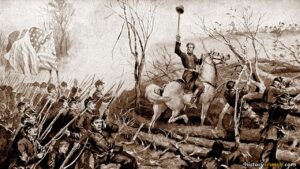
On the morning of April 9th, 1865, Gordon’s Confederate soldiers attacked the Union cavalry blocking the road west of Appomattox Court House. The attack initially succeeded in pushing the Union cavalrymen back. For a brief moment it appeared that the escape route might be open. However, as Gordon’s men advanced over the ridge, they saw a sight that ended all hope of escape. Waiting behind the Union cavalry were the Union 5th and 24th infantry corps, thousands of soldiers formed for battle across the road. Gordon sent word to Lee that his position was hopeless unless the infantry could support him. The infantry could not support him because it was already engaged against other Union forces approaching from the east.
Lee received Gordon’s message and understood that the situation was beyond recovery. He said that there was nothing left for him to do but go and see General Grant. He sent a message to Grant requesting a meeting to discuss the surrender of the Army of Northern Virginia.
Battle of Appomattox Court House – Surrender
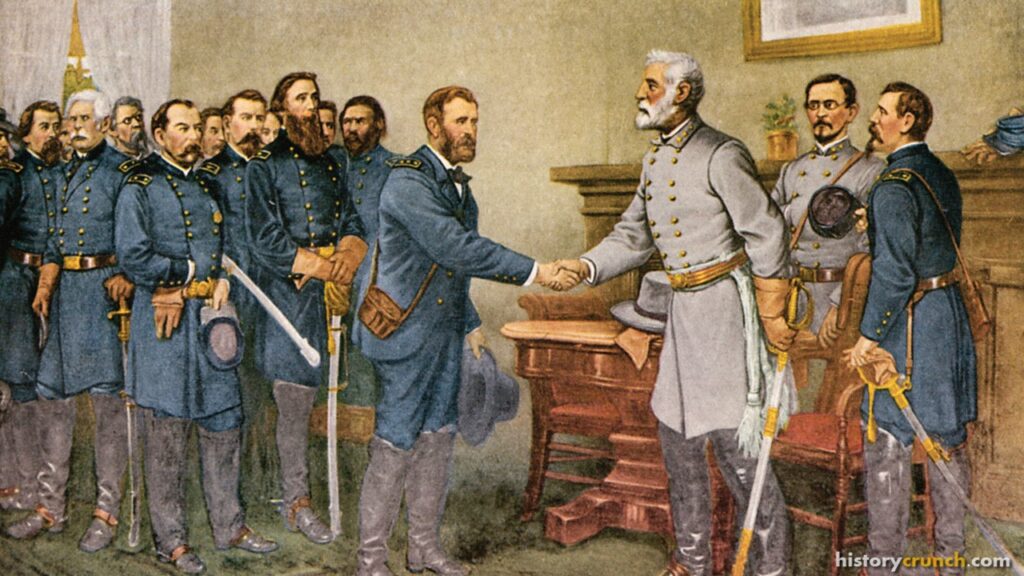
Grant received Lee’s message and rode to meet him at the village of Appomattox Court House. Lee chose a large brick house owned by a man named Wilmer McLean as the meeting place. The two generals met in McLean’s parlor on the afternoon of April 9th, 1865. They had briefly met before, during the Mexican-American War nearly twenty years earlier. Grant offered generous terms. Confederate soldiers would be paroled and allowed to return to their homes. They would not be arrested or tried for treason. Officers could keep their sidearms and their personal horses. Common soldiers who owned horses could also keep them to use for the spring planting season at home.
Lee accepted the terms and signed the surrender documents. Approximately 28,251 Confederate soldiers were paroled at Appomattox Court House in the days that followed. A formal ceremony marking the official disbanding of the Army of Northern Virginia took place on April 12th, 1865. As the Confederate soldiers marched forward to lay down their arms and flags, Union General Joshua Chamberlain, who had fought in many of the major battles of the war, ordered his soldiers to come to attention and salute their defeated opponents. It was a moment that many soldiers on both sides remembered for the rest of their lives.
Significance of the Battle of Appomattox Court House
The Battle of Appomattox Court House and the surrender that followed it are among the most significant events in American history. The surrender of Lee’s Army of Northern Virginia effectively ended the Civil War in the Eastern Theater and made the end of the entire war a matter of days and weeks rather than months. Other Confederate armies and commanders followed Lee’s example. General Johnston surrendered the Army of Tennessee to Sherman in North Carolina on April 26th. The last significant Confederate force surrendered on June 2nd, 1865. The Battle of Appomattox Court House is also remembered for the generous and respectful way in which Grant handled the surrender, which helped to begin the long and difficult process of reuniting a country that had been torn apart by four years of war.