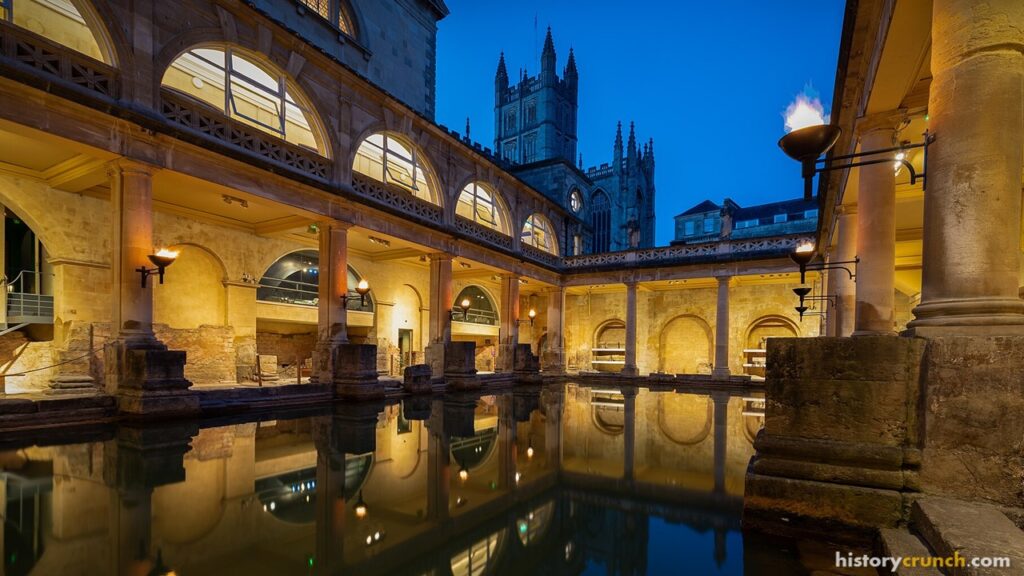
Baths in Ancient Rome (also known as thermae) were one of the most interesting features of Ancient Roman society. More than just places to get clean, Roman baths served as centers of social life, culture, and leisure for the people of Ancient Rome. In fact, historians argue that the baths displayed the Romans’ commitment to health, hygiene, and community. As such, baths in Ancient Rome were important centers that highlighted the amazing architecture and social values of the time.
BATHS IN ANCIENT ROME – HISTORY
As stated above, baths in Ancient Rome were very important to the people of the time. As such, Roman baths played a significant role in Roman society throughout much of the history of the Roman Empire. For instance, the history of baths in ancient Rome dates back to the early Republic, around the 3rd century BCE. At first, bathing was a luxury enjoyed mainly by the wealthy, but as Roman society and engineering advanced, baths became larger, more affordable and open to the general public. In fact, by the 1st century BCE, under leaders such as Julius Caesar and Agrippa, public baths were built across Rome and its vast empire. More specifically, Agrippa, a close friend of Emperor Augustus, constructed the first great public bath complex in Rome around 25 BCE. This was important because it set the model for later emperors to follow in bath construction. In fact, over time, emperors competed to build even grander bathhouses.
The construction of massive public baths in Ancient Rome reached its peak during the Imperial period, especially between the 1st and 4th centuries CE. Furthermore, the Baths of Nero, the Baths of Trajan, and the Baths of Caracalla (completed in 216 CE) were among the most impressive structures in the ancient world. In fact, the Baths of Diocletian, completed around 306 CE, were the largest of all, capable of holding thousands of bathers at once. These enormous bath complexes covered acres of land and highlighted the amazing engineering and architectural skill of the Ancient Romans. As well, the Romans were famous for their use of aqueducts to move and direct water over vast distances.
The decline of the Roman baths began in the 4th and 5th centuries CE, as the Roman Empire weakened. Economic troubles, invasions, and the decay of aqueduct systems made it harder to maintain large bath complexes. Additionally, the rise of Christianity changed social attitudes toward bathing and luxury.
BATHS IN ANCIENT ROME – PURPOSE AND SIGNIFICANCE
As has been shown above, the baths of Ancient Rome were important structures and centers that played a significant role in Roman society. For instance, almost all Roman cities and towns had public baths. They were social centers where Romans came together to participate in social life. As well, the baths were places for Romans to swim, bathe and stay fit. Rome itself had hundreds of baths, including the huge Baths of Caracalla which was a magnificent palace of marble that covered 27 acres.
Most Romans visited the baths on a daily basis in order to exercise and stay healthy. After exercising, the people would bath in different temperature pools. The bathers would scrub themselves with olive oil and then bathe in the pools.
The baths included not just pools and bathing rooms, but also libraries, gardens, gymnasiums, lecture halls, and even theaters. They were truly important civic centers for the people of Ancient Rome. Many of the baths were heated by complex systems of underground furnaces that circulated hot air beneath the floors the baths. This effectively allowed the baths to be used year-round, regardless of the weather.
Most Roman baths contained the following:
- Open Air Swimming Pool
- Tepidarium (Warm Room)
- Calidarium (Steam Room)
- Frigidarium (Cold Water Room)
- Gymnasium