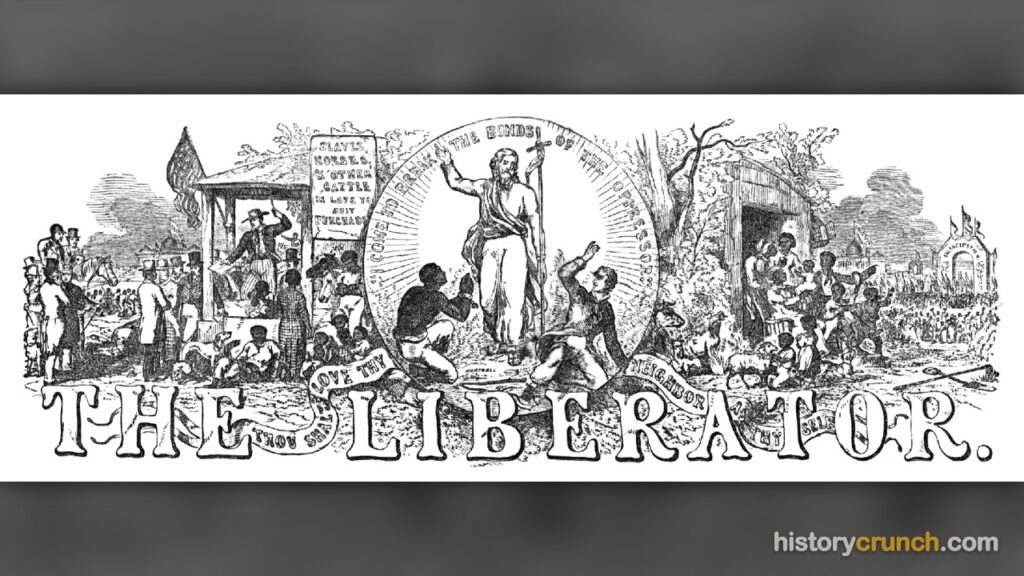
The Liberator was one of the most important newspapers in American history because it helped turn public opinion in the North against slavery and gave the growing abolitionist movement a powerful and lasting voice. First published on January 1st, 1831, in Boston, Massachusetts, it was a weekly antislavery newspaper edited by William Lloyd Garrison. For 35 years, it argued that slavery was a moral evil and demanded that it be ended immediately across the United States.
An abolitionist newspaper was a printed publication created to fight against slavery by spreading antislavery ideas, news, and arguments to as many readers as possible. In the case of The Liberator, this meant printing essays, speeches, letters, and reports that exposed the cruelty of slavery and called for its complete end. The goal was to change how ordinary people thought, so that they would join the cause and pressure the country to abolish slavery for good.
What Was the American Abolitionist Movement?
The American Abolitionist Movement was the overall effort in the United States to end the practice of slavery. It is generally considered to have taken place from the late 1700s until 1865, when slavery was finally abolished after the American Civil War. The word “abolish” means to stop or end something, so an abolitionist was a person who worked to ban slavery completely.
In fact, the movement grew stronger in the 1830s during a period of religious revival known as the Second Great Awakening. This wave of Protestant preaching taught that people had the power to fight sin and improve society, and many reformers came to view slavery as a terrible sin that had to be ended right away. As a result, abolitionists began to organize, publish, and speak out more boldly than ever before.
More specifically, abolitionists used many different tactics to spread their message. They sent petitions to Congress, gave speeches, formed antislavery societies, and printed newspapers, pamphlets, and books. The Liberator became one of the most famous of these publications, and it stood at the center of the movement for decades.
Who Was William Lloyd Garrison?
William Lloyd Garrison was the editor and founder of The Liberator, and he is considered one of the most important figures in the abolitionist movement. He was born in Newburyport, Massachusetts, on December 10th, 1805, into a poor family. His father left when Garrison was young, and his mother struggled to raise the children, so Garrison received very little formal schooling.
As a teenager, Garrison began working for newspapers, which taught him how to write and print. Over time, he became involved in journalism and reform, and he eventually joined the fight against slavery. For a while, he even worked with another antislavery editor on a newspaper called the Genius of Universal Emancipation, which introduced him to the abolitionist cause.
In his early years, Garrison supported a plan called colonization, which called for sending free Black Americans to Africa. However, he changed his mind after meeting free Black abolitionists and reading their work. He came to believe that slavery had to end immediately and that Black Americans deserved full freedom and equal rights in the country where they lived.
How Did The Liberator Begin?
Garrison published the first issue of The Liberator on January 1st, 1831, in Boston, together with his friend and business partner Isaac Knapp. From the very start, the newspaper took a bold and uncompromising position. Rather than asking for slavery to be ended slowly over many years, Garrison demanded that it be ended right away, a belief known as immediatism.
In the very first issue, Garrison made his purpose clear with a famous statement declaring that he would not soften his words or back down. He promised to speak the truth about slavery no matter how much opposition he faced. This fiery tone set the pattern for the newspaper and made Garrison one of the most talked-about reformers in the country.
The Liberator was published in Boston, a city with deep roots in the fight for American liberty. Garrison believed it was fitting to demand freedom for enslaved people in the same region that had helped start the American Revolution. In reality, though, he found that many Northerners were still hostile or indifferent to the antislavery cause, which made his mission even more difficult.
What Did The Liberator Say About Slavery?
The main message of The Liberator was that slavery was a moral wrong that had to be ended completely and immediately. Garrison argued that both enslaved people and slaveholders suffered under the system, and he insisted that no gradual or partial solution was acceptable. For this reason, the newspaper became known as the most radical and outspoken antislavery publication of its time.
Garrison believed in a method called moral suasion, which meant persuading people to reject slavery by appealing to their conscience and sense of right and wrong. Instead of relying on politics, he tried to convince readers that slavery was a sin and that good people had a duty to oppose it. He hoped that if enough Americans saw how immoral slavery was, they would join the campaign to end it.
The newspaper also broke with the idea of colonization, which Garrison had once supported. As stated above, he came to insist that abolition, not sending Black Americans away, was the true answer to slavery. This position helped shift the direction of the entire antislavery movement in the United States.
In addition, The Liberator became a kind of community bulletin board for abolitionists. It frequently printed and reprinted letters, sermons, reports, and news stories about slavery from across the country. In this way, it connected reformers to one another and helped build a united movement.
Who Read The Liberator?
Even though The Liberator became very famous, its actual number of subscribers was fairly small, at only about 3,000 paying readers. Despite this modest circulation, the newspaper reached a much wider audience because its articles were reprinted and discussed far beyond its list of subscribers. Nearly every leading abolitionist in the country read it.
Importantly, a large share of the newspaper’s readers were free Black Americans living in the Northern states. In fact, in its early years, most of its subscribers were African Americans, and Black abolitionists gave Garrison strong financial support that helped keep the paper alive. This made The Liberator an example of Black and white reformers working together toward a common goal.
The newspaper also created a strong reaction in the South, where slaveholders viewed it as a serious threat. Some Southern leaders wrongly assumed that The Liberator spoke for most Northerners, and they responded by defending slavery more fiercely and passing harsher laws to silence any opposition. As a result, the newspaper was banned in many parts of the South.
What Controversies Surrounded The Liberator?
Garrison’s strong opinions made The Liberator one of the most controversial newspapers in the country. He and his followers, who were sometimes called Garrisonians, attracted loyal supporters but also many bitter enemies. His views were so bold that even some fellow abolitionists disagreed with him.
One of the biggest controversies involved the United States Constitution. Garrison argued that the Constitution was a proslavery document because it allowed slavery to exist, and he refused to take part in a political system he saw as corrupt. This position was so extreme that he once publicly burned a copy of the Constitution to protest it.
These beliefs eventually caused splits within the abolitionist movement. For instance, some reformers broke away to form political parties and run candidates for office, which Garrison opposed. His disagreement over the Constitution and other issues also led to a famous falling out with the Black abolitionist and former enslaved man Frederick Douglass, who came to believe that political action could help end slavery.
The Liberator also supported women’s rights and gave women a role in the antislavery cause. While Garrison saw this as part of the fight for equality, some abolitionists felt it distracted from the goal of ending slavery. This disagreement was one of several that divided the movement during these years.
Significance of The Liberator Newspaper
The Liberator is significant because it became the most influential antislavery newspaper in the United States before and during the Civil War. For 35 years, it kept the issue of slavery in front of the American public and refused to let people ignore it. Its uncompromising demand for immediate emancipation helped push the entire nation toward the debate that would eventually end slavery.
The newspaper also gave the abolitionist movement a unifying voice. By printing letters, speeches, and reports from reformers everywhere, it connected abolitionists into a single, organized cause. It helped launch antislavery societies and inspired countless people to join the fight against slavery.
Finally, The Liberator showed the power of the printed word to change a nation. Garrison published the final issue on December 29th, 1865, the same year the Thirteenth Amendment abolished slavery. Having seen his life’s goal achieved, he declared that his work as an abolitionist was finished, and the newspaper ended its historic run.
Frequently Asked Questions
When was The Liberator published?
The Liberator was published weekly from January 1st, 1831, to December 29th, 1865, a span of 35 years. It was one of the longest-running abolitionist newspapers of its time. Its final issue came out the same year slavery was abolished in the United States.
Where was The Liberator printed?
The Liberator was printed and published in Boston, Massachusetts. Boston was a center of reform and antislavery activity in the North, which made it a fitting home for the newspaper. From there, its ideas spread across the country and even overseas.
Why was The Liberator so controversial?
The Liberator was controversial because it demanded the immediate end of slavery at a time when even many antislavery Americans wanted only gradual change. Garrison also attacked the Constitution as a proslavery document and refused to compromise on any point. These bold stands made him admired by some and hated by others.
How many people read The Liberator?
The Liberator had only about 3,000 paying subscribers, which was a small number even for its time. However, its influence was far greater than its circulation because its articles were reprinted and debated widely. Many of its subscribers were free Black Americans in the North who supported the paper.
What is the difference between The Liberator and The North Star?
The Liberator was edited by William Lloyd Garrison, while The North Star was founded later by Frederick Douglass. Both were antislavery newspapers, but Douglass came to believe in using politics and the Constitution to fight slavery, which put him at odds with Garrison. Their disagreement reflected a larger split within the abolitionist movement over the best way to achieve freedom.
Cite This Article
To cite this article as a source, use one of the formats below.
MLA: Millar, B. “The Liberator Newspaper: A Detailed Summary.” HistoryCrunch, 16 August 2026, https://historycrunch.com/liberator-newspaper/.
APA: Millar, B. (2026). The Liberator Newspaper: A Detailed Summary. HistoryCrunch. https://historycrunch.com/liberator-newspaper/
Chicago: Millar, B. “The Liberator Newspaper: A Detailed Summary.” HistoryCrunch. August 16, 2026. https://historycrunch.com/liberator-newspaper/
Sources
- Jerry Bentley & Herbert Ziegler, Traditions & Encounters: A Global Perspective on the Past.
- J.M. Roberts & Odd Arne Westad, The Penguin History of the World.