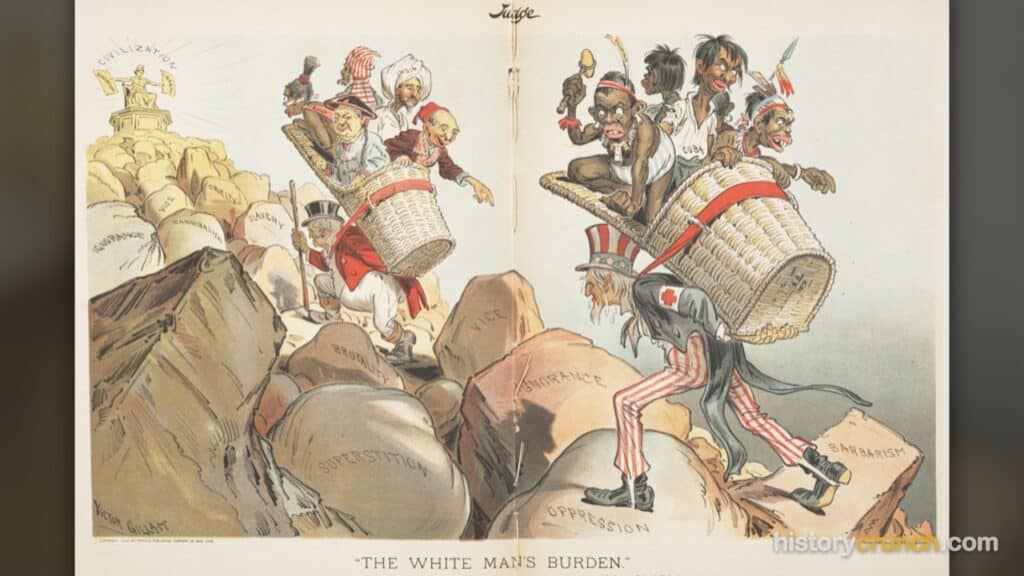
The White Man’s Burden was one of the most important ideas used to justify European and American imperialism during the late 19th and early 20th centuries. It was the belief that white people of European descent had a moral duty to rule over, control, and “civilize” the non-white peoples of Africa, Asia, and other regions of the world. The phrase came from a famous poem written in 1899, and it quickly became a way for powerful nations to make their conquest of foreign lands seem noble and good rather than greedy or cruel.
In simple terms, the White Man’s Burden was a rationalization, meaning an excuse that made an unfair action seem reasonable. Supporters of the idea claimed that non-European peoples were “backward” and unable to govern themselves, so it was the “burden,” or heavy responsibility, of white nations to take charge of them. This idea was closely tied to racism because it assumed that Europeans were naturally superior to everyone else. In reality, it was used to defend the seizing of land, resources, and labor from millions of people around the world.
What Was the Age of Imperialism?
The White Man’s Burden belongs to a period in world history known as the Age of Imperialism. Imperialism is a term that relates to when one country extends its political, economic, or cultural authority over another country or region. This usually involved a powerful nation taking over a weaker one through direct invasion, political control, or by dominating its economy.
The Age of Imperialism lasted from about the middle of the 18th century until the early part of the 20th century. During this time, the major European nations, along with the United States, Russia, and Japan, expanded their influence across large sections of Africa and Asia. Britain built the largest empire in history, controlling roughly one quarter of the land on Earth, while France, Germany, Belgium, Italy, Portugal, and Spain also seized enormous territories.
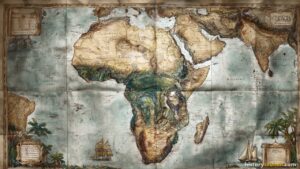
Historians generally identify five main causes of the Age of Imperialism: economic gain, colonization, religion, ethnocentrism, and prestige. The White Man’s Burden is connected most closely to the cause called ethnocentrism, which is the belief that one’s own culture or group is superior to all others. This sense of superiority gave Europeans the confidence, in their own minds, to dominate the people they encountered. One of the clearest examples of this domination was the Scramble for Africa, which took place from about 1870 to 1914 and saw almost the entire continent divided among the European powers.
Where Did the Phrase White Man’s Burden Come From?
The phrase White Man’s Burden comes from a poem of the same name written by the British author Rudyard Kipling. The poem was published in an American magazine called McClure’s Magazine in February of 1899. Kipling was one of the most famous writers in the English-speaking world at the time, and he was well known as a strong supporter of the British Empire.
In the poem, Kipling called on Europe and the United States to “send forth the best ye breed” and to “take up the white man’s burden.” More specifically, he was urging the United States to take control of the Philippine Islands and to accept the task of ruling and “civilizing” the people there. The poem presented this work as a difficult and thankless duty, but also as a noble mission that white nations were morally required to carry out.
Kipling’s message was that people of European descent were superior to other peoples of the world. In his view, the “burden” of the white man was to “fix” or improve societies he considered uncivilized. For this reason, the poem became a symbol of the racist thinking that lay behind much of imperialism.
How Did the Idea Connect to the Spanish-American War?
Kipling wrote the poem at a very specific moment in American history. In 1898, the United States fought and won the Spanish-American War, a short conflict against Spain. As a result of this victory, the United States suddenly became a colonial power for the first time on a large scale.
Following the war, Spain gave up its claims to Cuba and handed over control of Guam, Puerto Rico, and the Philippines to the United States. This left Americans with a major question. In fact, many Americans argued fiercely about whether the United States should keep these new territories or grant them independence.
Kipling’s poem entered directly into this debate. It encouraged Americans who supported expansion to believe that taking over the Philippines was a righteous and honorable act. As stated above, the poem framed conquest as a moral responsibility, which made it a powerful tool for those who wanted the United States to build an empire of its own.
How Did White Man’s Burden Relate to Social Darwinism?
The White Man’s Burden was closely linked to another idea from the same period called Social Darwinism. Social Darwinism is the belief that some groups of people are superior to others and are therefore more “fit” to rule over those seen as less “fit.” It took the scientific theory of evolution developed by Charles Darwin and wrongly applied it to human societies and races.
Charles Darwin was the British scientist who explained the biological theory of evolution in his book Origin of Species. While Darwin was writing about plants and animals, others took his ideas about “survival of the fittest” and stretched them to argue that certain peoples and nations were naturally destined to dominate others. In this way, supporters of Social Darwinism tried to make their ethnocentric and racist beliefs look like proven science.
The beliefs of ethnocentrism and Social Darwinism can be seen clearly in Kipling’s poem. By claiming that white Europeans were biologically superior, these ideas encouraged the European powers to feel justified in dominating the people they encountered. As a result, this sense of superiority helped drive events such as the Scramble for Africa and contributed to terrible abuses, including the brutal rule of Belgian King Leopold II in the Congo.
How Did People React to the Poem?
When the poem was published, it received a strong response from both sides of the debate over imperialism. Supporters of expansion embraced it warmly. Some leading American politicians who favored building an empire agreed that the poem made good sense from the point of view of expansion.
At the same time, many people rejected the poem and its message. Critics argued that the White Man’s Burden was not a noble duty at all but simply a cover for greed and cruelty. In reality, they pointed out, imperialism was mostly about money, land, and power rather than helping anyone.
The events that followed seemed to prove the critics correct. Beginning in 1899 and lasting until 1902, the people of the Philippines revolted against American rule, just as they had earlier fought against Spain. A bitter three-year war followed as the United States fought to keep control of the islands, and the conflict caused enormous suffering for the Filipino people.
Significance of White Man’s Burden
The significance of the White Man’s Burden lies in how it reveals the thinking that powered the Age of Imperialism. More specifically, it shows how powerful nations used ideas about race and morality to excuse the conquest and exploitation of millions of people. Rather than admitting that imperialism was driven by money and power, supporters dressed it up as a generous and civilizing mission.
The idea also had a lasting impact because it strengthened racist beliefs that harmed colonized peoples for generations. By treating whole cultures as “backward” and in need of white control, the White Man’s Burden erased local traditions, languages, and forms of government. In many regions, the damage done during this period continued long after the empires themselves came to an end.
Today, the phrase is remembered as a symbol of the contradictions of imperialism. It reminds readers that claims of “helping” or “civilizing” other people were often used to hide the exploitation taking place. For this reason, the White Man’s Burden remains an important example of how language and ideas can be used to justify injustice.
Frequently Asked Questions
What does the White Man’s Burden mean?
The White Man’s Burden means the false belief that white people had a moral duty to rule over and “civilize” non-white peoples. The word “burden” was meant to suggest that governing these regions was a heavy but noble responsibility. In truth, it was an excuse used to justify taking land, resources, and power from others.
Who wrote the poem The White Man’s Burden?
The British author Rudyard Kipling wrote the poem The White Man’s Burden in 1899. Kipling was one of the most popular writers of his time and later won the Nobel Prize in Literature in 1907. He was also known as a firm believer in the British Empire and its expansion.
Why was the White Man’s Burden written for the United States?
The poem was aimed at the United States because Americans were deciding what to do with the Philippines after the Spanish-American War. Kipling wanted to convince the United States to keep the islands and take up the role of a colonial power. The poem’s full title even referred directly to the United States and the Philippine Islands.
How was the White Man’s Burden used to justify imperialism?
The idea justified imperialism by claiming that conquest was a kindness rather than a form of theft. Leaders argued that non-European peoples could not govern themselves and needed Western rule, religion, and education to improve. This allowed nations to present the seizing of colonies as a caring mission instead of an act of greed.
Why is the White Man’s Burden considered racist?
It is considered racist because it assumed that white Europeans were naturally superior to all other peoples. The idea described non-white populations as childlike and uncivilized, which dehumanized them and denied their right to rule themselves. These beliefs were connected to Social Darwinism, which tried to make such prejudice look scientific.
Cite This Article
To cite this article as a source, use one of the formats below.
MLA: Millar, B. “White Man's Burden: A Detailed Summary.” HistoryCrunch, 12 August 2026, https://historycrunch.com/white-mans-burden/.
APA: Millar, B. (2026). White Man's Burden: A Detailed Summary. HistoryCrunch. https://historycrunch.com/white-mans-burden/
Chicago: Millar, B. “White Man's Burden: A Detailed Summary.” HistoryCrunch. August 12, 2026. https://historycrunch.com/white-mans-burden/
Sources
- Jerry Bentley & Herbert Ziegler, Traditions & Encounters: A Global Perspective on the Past.
- J.M. Roberts & Odd Arne Westad, The Penguin History of the World.