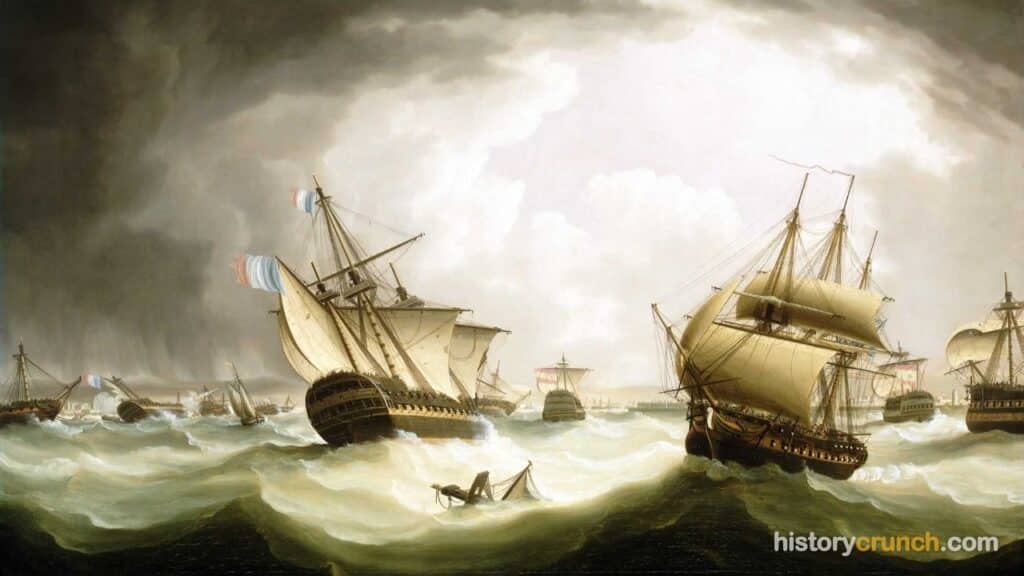
The Battle of Trafalgar, fought on October 21st, 1805, was the most important naval battle of the Napoleonic Wars, establishing British supremacy at sea and ending Napoleon Bonaparte‘s hopes of invading England. The battle was fought off Cape Trafalgar on the southwestern coast of Spain, between the British Royal Navy and the combined fleets of France and Spain. A British fleet of 27 ships commanded by Vice-Admiral Horatio Nelson defeated a Franco-Spanish force of 33 ships commanded by French Vice-Admiral Pierre de Villeneuve. The result was an overwhelming British victory that reshaped the war at sea for more than a century.
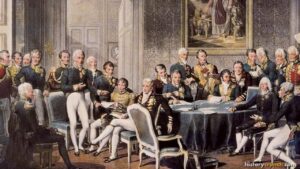
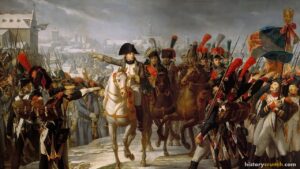
The Napoleonic Era refers to the period of French and European history dominated by Napoleon Bonaparte, lasting from his seizure of power in France in 1799 to his final defeat and exile in 1815. During these years, Napoleon built one of the largest empires in European history and fought a long series of wars against shifting coalitions of European powers. Trafalgar was a key event within this era, and it belongs to the wider struggle known as the War of the Third Coalition.
Background of the Battle of Trafalgar
By the early 1800s, Britain and France were locked in a deadly contest for control of Europe. Napoleon’s armies dominated the continent by land, but Britain’s command of the seas remained the one obstacle standing between him and total power. In 1805, Napoleon gathered a large army along the English Channel coast, preparing to invade Britain itself. To make that invasion possible, he first needed to win control of the Channel, and that meant defeating or drawing away the Royal Navy.
Napoleon’s plan depended on a clever deception. He hoped to trick the British into believing that his combined French and Spanish fleet was sailing to attack colonies in the West Indies. If the Royal Navy chased the fleet across the Atlantic, the French believed they could double back and seize control of the Channel long enough for the army to cross. In reality, the plan fell apart. The combined fleet, under Admiral Villeneuve, ended up sheltering in the Spanish port of Cadiz rather than gaining command of the sea.
Villeneuve was reluctant to fight. His ships had spent much of the war bottled up in port by British blockades, which left his crews with little chance to train at sea or practice with their guns. He finally led the fleet out of Cadiz only after learning that Napoleon intended to replace him as commander. Light winds meant the fleet took a long time to leave port, and the ships were still trying to regain their formation when the British appeared on the morning of October 21st, 1805.
The two sides were not evenly matched in numbers. The British brought 27 ships of the line, supported by several smaller frigates, while the French and Spanish assembled 33 ships of the line. The combined fleet even included the Spanish ship Santisima Trinidad, which carried 136 guns and was the largest warship afloat at the time. Despite being outnumbered, the British held a crucial advantage in training. Years of constant time at sea had made British gun crews far faster and more accurate than their opponents, who had rarely fired their cannon under real conditions.
Command of the British fleet rested with Vice-Admiral Horatio Nelson, one of the most respected naval commanders in British history. Nelson sailed aboard his flagship, HMS Victory, with Captain Thomas Hardy at his side. The second British column was led by his close friend, Vice-Admiral Cuthbert Collingwood, aboard HMS Royal Sovereign. On the opposing side, Villeneuve commanded from the French flagship Bucentaure. As the two fleets drifted toward each other in light winds, Nelson signaled his famous message to encourage the men, “England expects that every man will do his duty.”
How the Battle of Trafalgar Unfolded
In the age of sail, most fleets fought by lining up parallel to each other and trading long-range broadsides, a cautious method that often ended in a bloody stalemate. Nelson rejected that approach entirely. Instead, he planned to break the enemy line by attacking it head on. His 27 ships would advance in two columns sailing at right angles to the enemy formation, smashing through it in two places rather than fighting alongside it.
The purpose of this bold plan was to cut the long Franco-Spanish line into separate pieces. By slicing through the enemy formation, Nelson could isolate the rear and center of the combined fleet and overwhelm those ships before the leading enemy vessels could turn around to help. It was a risky gamble, because the leading British ships would have to sail straight into enemy fire without being able to shoot back at first. Nelson trusted that superior British gunnery and discipline would win the close combat that followed.
The battle began around midday when the French ship Fougueux fired the first shots at Collingwood’s Royal Sovereign. Collingwood’s ship was the first to break through the enemy line, cutting behind the Spanish flagship Santa Ana and raking it with a punishing broadside. A broadside fired through the stern of an enemy ship was especially deadly, since the cannonballs could travel the entire length of the crowded gun decks.
Nelson’s Victory followed soon after and steered toward the center of the line. Spotting Villeneuve’s flag flying on the Bucentaure, Nelson directed Victory to attack it directly. The Victory passed under the stern of the Bucentaure and delivered a devastating broadside that crippled the French flagship. As the Victory pushed forward, it became entangled with the smaller French ship Redoutable, and the two vessels drifted together in a deadly close-range struggle.
This clash opened a wide gap in the enemy line, exactly as Nelson had planned. The British ships following behind Victory poured through the gap and split the combined fleet in two. The fighting quickly became a chaotic melee, with ships firing on any enemy vessel that came within range. In these close quarters, the faster and more accurate British gunnery proved decisive, pounding the French and Spanish ships far more quickly than they could reply.
At about 1:15 in the afternoon, disaster struck the British command. As Nelson paced the quarterdeck of Victory alongside Captain Hardy, a French marksman firing from the rigging of the Redoutable shot him in the shoulder. The wound proved fatal, and Nelson was carried below deck. He lived just long enough to learn that his fleet was winning a complete victory, dying aboard his flagship as the battle drew to a close.
By late afternoon, the combined fleet had collapsed into disorder. The leading enemy ships tried to turn back to aid their comrades, but unfavorable winds and waiting British warships broke up their weak counterattack. Villeneuve himself was captured along with his flagship. The battle ended around five o’clock in the evening, with 17 enemy ships captured and not one British ship lost. In total, the combined fleet lost around 18 ships to capture or destruction. British casualties came to roughly 450 killed and 1,250 wounded, while French and Spanish losses were far heavier, with thousands killed and wounded and around 20,000 more taken prisoner.
The triumph was quickly followed by hardship. A fierce storm blew up after the battle, forcing the British to abandon most of the enemy ships they had captured. News of the victory reached London about two weeks later, in the early hours of November 6th, 1805. Public celebration was mixed with deep sorrow at the death of Nelson, who was mourned across Britain as a national hero.
Significance of Battle of Trafalgar
The most immediate result of Trafalgar was the permanent end of Napoleon’s plan to invade Britain. With his combined fleet shattered, Napoleon could no longer hope to win control of the English Channel, and the threat of a French landing on British soil faded for the rest of the war. From that point on, Napoleon focused his ambitions almost entirely on land campaigns in Europe rather than on the sea.
Trafalgar also confirmed British naval supremacy beyond any doubt. The Royal Navy had proven that its superior training, professionalism, and tactics set it far apart from its rivals. This dominance at sea would last for more than a century, allowing Britain to protect its trade, expand its empire, and shape world events long after the Napoleonic Wars ended.
The timing of the battle revealed a fundamental strategic paradox of the Napoleonic Wars. Trafalgar was fought around the same time that Napoleon was marching toward his greatest land victory at the Battle of Austerlitz in December of 1805. In this way, France remained supreme on land while Britain became supreme at sea. Neither side could easily strike the other, which produced a long stalemate that shaped the entire course of the conflict.
Finally, Trafalgar became one of the most celebrated events in British history and cemented Nelson’s reputation as a national hero. His daring plan of attack and his death at the moment of victory turned the battle into a lasting symbol of British courage and skill. For these reasons, the Battle of Trafalgar remains one of the most important naval engagements ever fought.
Frequently Asked Questions
When and where was the Battle of Trafalgar fought?
The Battle of Trafalgar was fought on October 21st, 1805, off Cape Trafalgar on the southwestern coast of Spain, near the port city of Cadiz. It took place in the Atlantic Ocean, just outside the entrance to the Mediterranean Sea. The location gave the name Trafalgar to one of the most famous battles in naval history.
Who won the Battle of Trafalgar?
Britain won the Battle of Trafalgar in a decisive and one-sided victory. The Royal Navy captured or destroyed about 18 enemy ships while losing none of its own. The scale of the win was so complete that it removed the French and Spanish fleets as a serious threat for the rest of the war.
How did Admiral Nelson die at Trafalgar?
Nelson was fatally shot by a French marksman firing from the rigging of the ship Redoutable, which had become tangled with his flagship Victory. He was struck in the shoulder while walking the deck in his full admiral’s uniform, which made him an easy target. He was carried below and died a few hours later, aware that his fleet had won.
Why was the Battle of Trafalgar so important?
Trafalgar was important because it ended Napoleon’s plan to invade Britain and secured British control of the seas for over a hundred years. This naval dominance protected British trade and allowed the country to expand its influence around the world. It also forced Napoleon to focus on land warfare, since he could no longer challenge Britain at sea.
Why was the British navy better than the French and Spanish at Trafalgar?
The British navy was more effective mainly because of superior training and experience. British crews spent years at sea and could load and fire their cannon much faster and more accurately than their opponents. The French and Spanish fleets, by contrast, had been blockaded in port for long stretches, which left their sailors with little practice and their gunnery slow and unreliable.
Cite This Article
To cite this article as a source, use one of the formats below.
MLA: Millar, B. “Battle of Trafalgar: A Detailed Summary.” HistoryCrunch, 11 August 2026, https://historycrunch.com/battle-of-trafalgar/.
APA: Millar, B. (2026). Battle of Trafalgar: A Detailed Summary. HistoryCrunch. https://historycrunch.com/battle-of-trafalgar/
Chicago: Millar, B. “Battle of Trafalgar: A Detailed Summary.” HistoryCrunch. August 11, 2026. https://historycrunch.com/battle-of-trafalgar/
Sources
- J.M. Roberts & Odd Arne Westad, The Penguin History of the World.
- Jerry Bentley & Herbert Ziegler, Traditions & Encounters: A Global Perspective on the Past.