The Loyalist militia played a major role in shaping how the American Revolution was fought, especially in the South and along the frontier, where the conflict often became a bitter civil war between neighbors. Loyalist militia were groups of American colonists who took up arms to support Great Britain and King George III against the Patriots who were fighting for independence. The American Revolution is usually remembered as a struggle between Britain and the colonies, but in reality many of the people fighting on the British side were Americans themselves.
A militia was a force of ordinary citizens, rather than full-time professional soldiers, who could be called up to fight when needed and then return to their farms and shops. In the case of the Loyalist militia, these were local men who armed themselves to defend British rule in their own regions. They were different from the paid, uniformed British regulars, and they were also different from the Loyalist provincial regiments, which were more formally organized units raised for longer service in the British army.
What Was the American Revolution?
The American Revolution was the political and military struggle through which the Thirteen Colonies broke free from British rule and established the United States of America. It grew out of more than a decade of rising tension over taxation, trade, and the rights of colonists as British subjects. As stated above, no single event caused the war. Instead, a series of British policies and colonial responses pushed the two sides further apart until fighting broke out.
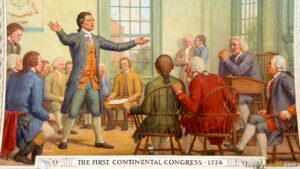
Open fighting began in April of 1775 at Lexington and Concord, and the colonies formally declared independence on July 4th, 1776. The war lasted until 1783. During those years, Britain sent regular soldiers and hired German troops known as Hessians, while the colonies raised the Continental Army under George Washington along with thousands of Patriot militiamen.
What is sometimes forgotten is that the Revolution was also a civil war among Americans. Not everyone in the colonies wanted independence. In fact, a large share of colonists either supported the British or tried to stay out of the fight entirely, and it was from this group that the Loyalist militia was drawn.
Who Were the Loyalists?
Loyalists, also referred to as Tories, Royalists, or King’s Men, were colonists in the Thirteen Colonies who remained loyal to the British crown. Historians generally estimate that about one-fifth of the colonial population supported Britain during the war, though the exact number is impossible to know. The rest were divided between committed Patriots and a large middle group that tried to remain neutral.
The Loyalists were a very mixed group of people. They included individuals from various backgrounds such as Quakers, Native Americans, African Americans, and Scottish immigrants, as well as people from different social classes, and while some were motivated by self-interest or fear of disorder, others opposed the revolutionary cause for more complex reasons, including long-standing ethnic tensions and loyalty to British governance. Some were wealthy officials and merchants tied closely to Britain, while others were recent immigrants and frontier farmers.
For instance, some Scotch-Irish settlers in the newly settled backcountry sided with Britain in part because they distrusted the eastern elites who ran the colonies. Many enslaved and free Black Americans also joined the British side after the Crown promised freedom in exchange for military service. In this way, the Loyalist cause drew support from people with very different hopes and fears.
How Was the Loyalist Militia Organized?
British commanders believed that huge numbers of loyal colonists would rise up and fight once the British army arrived in a region. During the war, British strategy relied heavily upon the belief that the Loyalist community could be mobilized into Loyalist regiments, but expectations for support were never fully met. Time and again, fewer men turned out than the British had hoped.
Even so, the number who did serve was significant. In all, about 50,000 Loyalists served as soldiers or militia in the British forces, roughly 19,000 Loyalists were enrolled on a regular army status, and about 15,000 Loyalist soldiers and militia came from the Loyalist stronghold of New York. These figures show that the Loyalist contribution to the war was far from small.
More specifically, there was an important difference between ordinary militia and the provincial corps. Local militia were part-time fighters used mainly to defend their own area and support British operations nearby. Provincial units, by contrast, were part of an official system the British set up in 1775 to organize regiments raised in America as part of the army, and while locally raised militia were useful close to home, provincials were paid, armed, equipped, uniformed, fed, and disciplined the same as British soldiers, and were liable for service anywhere until the end of the war.
Major Loyalist Units and Their Campaigns
Several Loyalist units became well known during the war. More than 19,000 Loyalists served Britain in specially created provincial corps, such as the King’s Royal Regiment of New York and Butler’s Rangers. These units were often made up of Loyalist families who had been driven from their homes by the Patriots and had fled north to Canada.
On the northern frontier, these units fought a brutal kind of warfare. Butler’s Rangers, active from 1777 to 1784, was a Loyalist provincial military unit raised by American Loyalist John Butler, and most of its members were Loyalists from upstate New York and northeastern Pennsylvania. The Rangers took part in numerous violent raids on the northern frontier, such as the Battle of Wyoming in July 1778 and the Cherry Valley massacre of November 1778, actions that earned them a reputation for ruthlessness.
Working alongside Native American allies, Loyalist units like these attacked farms and settlements throughout the Mohawk Valley in New York. Along with American Indian allies and fellow provincial regiments such as Butler’s Rangers, these forces fought a series of raiding campaigns through the Mohawk Valley, a major agricultural area of New York, and the raids were intended to cut off the supply of food to Washington’s army. This frontier fighting was some of the most bitter of the entire war.
In the South, the British raised their own Loyalist forces as they moved through the region. Georgia, as the new seat of British power in the South, raised its own provincial units, including the Georgia Loyalists under Major James Wright, and this corps spent most of the war defending Savannah. Other units such as the King’s Carolina Rangers and the South Carolina Royalists carried much of the fighting as the war shifted southward.
Why Was the Battle of Kings Mountain Important?
The most famous clash involving the Loyalist militia came in 1780. After major British victories at Charleston and Camden, the British hoped to raise thousands of Loyalist fighters in the Carolina backcountry. British Major Patrick Ferguson arrived in North Carolina in early September 1780 to recruit troops for the Loyalist militia and to protect the flank of Lord Cornwallis’s main force.
Ferguson’s threats against frontier settlers backfired badly. Instead of frightening them into surrender, they inspired Patriot militias from across the mountains, often called the Overmountain men, to gather and hunt him down. The battle took place on October 7th, 1780, about 9 miles (14 km) south of the present-day town of Kings Mountain, North Carolina, where the Patriot militia defeated the Loyalist militia commanded by Major Patrick Ferguson.
One striking fact about the battle is how few professional soldiers were involved. Leading a group of Loyalists whom he had recruited, Ferguson was the only regular army officer participating on either side of the conflict. Because of this, the fighting is often described as an all-American battle between Patriots and Loyalists.
The result was a crushing defeat for the Loyalists. The surprising victory of the Patriot militia came after a string of Patriot defeats at the hands of Cornwallis and greatly raised the Patriots’ morale, and with Ferguson dead and his Loyalist militia destroyed, Cornwallis transferred his army into North Carolina and eventually Virginia. As stated above, Thomas Jefferson later called the battle a turn of the tide in the war.
What Happened to the Loyalists After the War?
Life was often dangerous for Loyalists throughout the war. Loyalists faced harassment and violence from Patriots, who viewed them as traitors. Many had their property vandalized, seized, or burned, and some were driven from their communities entirely.
When the British lost the war, tens of thousands of Loyalists chose to leave rather than live in the new United States. After the Revolution, many Loyalists left the United States, seeking refuge in other British territories like Canada, the Caribbean, and Great Britain, where they often encountered hardship and feelings of exile. Between 80,000 and 100,000 eventually fled, about half of them to Canada. Their departure reshaped the population of British North America and helped build the future country of Canada.
Significance of Loyalist Militia in the American Revolution
The Loyalist militia matters because it shows that the American Revolution was not simply Americans against the British. In reality, it was also a civil war in which Americans fought other Americans over the question of independence. Neighbors, friends, and even members of the same family sometimes ended up on opposite sides.
The Loyalist militia also reveals a key weakness in British strategy. British commanders counted on huge numbers of loyal colonists rising up to help win the war, but that support never appeared in the numbers they expected. When Loyalist forces were crushed at battles like Kings Mountain, British hopes of holding the South collapsed with them.
Finally, the story of the Loyalist militia is a reminder that history includes the people who lost as well as those who won. The men and women who supported Britain believed they were the loyal and faithful subjects, yet they ended up as exiles. Their experiences form an important and often overlooked part of the overall history of the Revolution.
Frequently Asked Questions
What is the difference between a Loyalist and a Patriot?
A Loyalist supported Great Britain and the king, while a Patriot supported American independence. Patriots were also called Whigs or Rebels, and Loyalists were often called Tories or King’s Men. Both groups were made up of American colonists, which is why the Revolution is sometimes described as a civil war between Americans.
Why did some colonists become Loyalists?
Colonists became Loyalists for many different reasons, from personal loyalty to the king to fear of disorder and violence. Some had close business or family ties to Britain, some worked as royal officials, and some simply did not trust the local leaders who supported independence. Enslaved people sometimes joined the British after being promised their freedom in return for service.
How many Loyalists fought in the American Revolution?
About 50,000 Loyalists served as soldiers or militia for the British during the war. Of these, roughly 19,000 served in organized provincial corps that fought much like the regular British army. New York provided the single largest share of Loyalist fighters of any colony.
What was the most famous Loyalist militia battle?
The Battle of Kings Mountain in October of 1780 is the most famous battle fought mainly by Loyalist militia. It was unusual because almost everyone who fought was American, with the British officer Patrick Ferguson being the only regular soldier on the field. The Patriot victory there badly damaged British plans in the South.
Where did the Loyalists go after the Revolution?
Many Loyalists left the United States after the war and moved to other parts of the British Empire. Large numbers settled in Canada, especially in Nova Scotia, New Brunswick, and Quebec, while others went to Britain or the Caribbean. Their arrival helped shape the growth of Canada in the years that followed.
Cite This Article
To cite this article as a source, use one of the formats below.
MLA: Millar, B. “Loyalist Militia in the American Revolution: A Detailed Summary.” HistoryCrunch, 10 August 2026, https://historycrunch.com/loyalist-militia-in-the-american-revolution/.
APA: Millar, B. (2026). Loyalist Militia in the American Revolution: A Detailed Summary. HistoryCrunch. https://historycrunch.com/loyalist-militia-in-the-american-revolution/
Chicago: Millar, B. “Loyalist Militia in the American Revolution: A Detailed Summary.” HistoryCrunch. August 10, 2026. https://historycrunch.com/loyalist-militia-in-the-american-revolution/
Sources
- Yale Avalon Project
- Bernard Bailyn, The Ideological Origins of the American Revolution.
- National Archives — Founders Online