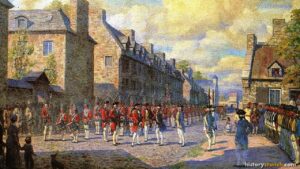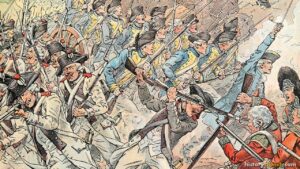
The soldiers who fought in the American Revolution carried the weight of a new nation on their shoulders, and their day to day experience shaped whether the fight for independence would succeed or fail. Between 1775 and 1783, tens of thousands of ordinary men left their farms, shops, and families to serve in the war that separated the Thirteen Colonies from Great Britain. Their lives were filled with long marches, poor food, harsh weather, disease, and the constant threat of battle. Understanding what these men endured helps explain how a group of untrained volunteers grew into an army that could stand against the most powerful military in the world.
The term “soldier of the American Revolution” usually refers to the men who served either in the local militia or in the Continental Army, which was the first official national army of the United States. A militia was a group of ordinary citizens who kept weapons at home and could be called out quickly in an emergency, while the Continental Army was a full time force of paid volunteers who enlisted for set periods of time. Both types of soldiers fought against British regulars and their hired German allies, and both faced the same hardships of camp and battlefield.
What Was the American Revolution?
The American Revolution was the conflict in which the Thirteen Colonies broke away from British rule and formed the independent United States of America. The war grew out of years of anger over taxes, trade rules, and a lack of political representation in the British government. Fighting began in April of 1775 at the Battles of Lexington and Concord, and it continued until 1783, when a peace treaty finally recognized American independence.
Soon after the fighting started, the Continental Congress decided the colonies needed a united military force rather than scattered local groups. On June 14th, 1775, the Second Continental Congress formed the Continental Army, and George Washington was appointed commander in chief, a position he held throughout the war. In fact, this new army was supported by the same colonial militias that had first taken up arms, and together they carried the burden of the entire war effort.
Who Were the Soldiers of the American Revolution?
The men who filled the ranks came from every part of colonial society. The Continental Army was a mixture of the thirteen states, drawing men from the maritime traditions of New England, the farms of the South, and the rugged western frontier. Most were young, and many were farmers who had never traveled far from home before the war.
Their reasons for enlisting varied widely. American soldiers came from all walks of life and had different reasons for joining, and for many young men enlisting gave them steady employment as well as the chance for excitement, adventure, and promises of land and cash bonuses, while others were driven by a strong belief in the ideals of the Revolution and a sense of duty to their community. As stated above, the army was more diverse than many people expect. The Continental Army had soldiers of multiple ethnicities, including African Americans and Native Americans, and at one time nearly ten percent of Washington’s army consisted of Black soldiers, making it an integrated force in a way the United States Army would not be again until the Korean War.
Overall, an enormous number of men passed through the ranks during the eight years of fighting. Over 230,000 soldiers served in the Continental Army during the American Revolution, although there were no more than 48,000 at any one time, and the largest number gathered in a single place for battle was 13,000.
How Did Men Join the Army?
Joining the army worked differently as the war went on. In the beginning, many men simply reported to their local militia, where great initial enthusiasm led many men to join local militias, and they often served under officers of their own choosing. Militia duty was a colonial tradition, and all military aged males, roughly 16 to 45, were required to serve in the militia and to keep the arms and equipment needed for service.
Enlistment terms in the Continental Army changed over time as leaders realized short service was not enough to win. When the war began, the Continental Congress set up the Continental Army with soldiers who enlisted for no more than a year, and they planned to return to their normal work when their service ended. More specifically, the rules were later made stricter. After 1778, Congress required men to serve for either three years or the duration of the war, and bounties were used to encourage enlistment, which could include extra money, extra clothing, or land west of the Ohio River where many veterans would settle after the war.
What Was Daily Life Like for a Soldier?
For most soldiers, the war was far more about routine than about combat. Regardless of which army they belonged to, soldiers had a daily life defined by routine, fatigue, and preparation for battle, with the day usually beginning at or just before dawn with a small breakfast, and a soldier on campaign might march all day carrying a heavy load. In reality, much of army life had nothing to do with the enemy at all. Military life was full of its own dangers even while no battles raged, and because machines did not exist to do simple tasks, camp life was full of manual labor, much of it repetitive.
Cleanliness in camp was a serious matter, even though people of the time did not fully understand how disease spread. The connection between cleanliness and health was well understood, and military textbooks stressed keeping camps clean, including frequently replacing the straw used for bedding, letting fresh air into buildings and tents, and disposing of waste only in designated places. For instance, soldiers were regularly encouraged to bathe when the weather and other conditions allowed.
What Weapons and Equipment Did Soldiers Use?
Armies of the American Revolution were organized in a clear structure. All of the armies consisted of regiments made up of smaller units called companies, and most regiments were made up of infantrymen, or foot soldiers. In addition, specialized units played important roles. Infantry regiments often included companies of specialized soldiers, such as grenadiers who were the tallest and strongest men and often led attacks, while armies also featured artillery, soldiers responsible for moving and operating cannons, and dragoons, soldiers equipped to fight both on horseback and on foot.
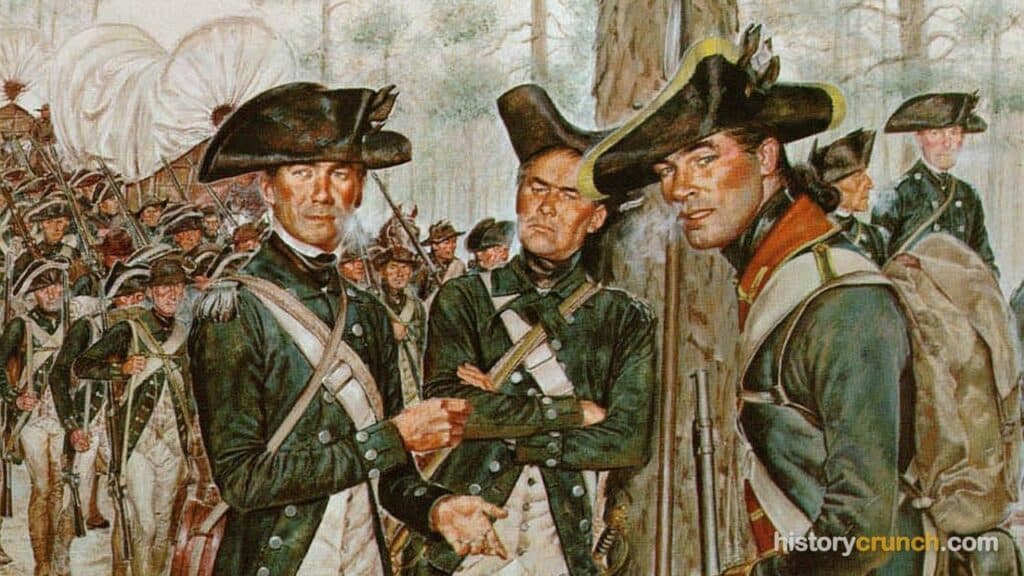
The main weapon of the common soldier was the musket, but some carried more accurate firearms. Some Continental, British, and Hessian soldiers carried rifles that could accurately hit targets up to 300 yards away, some soldiers who fought on horseback carried pistols and sabers, and officers often carried swords and spear-like weapons called spontoons as signs of rank. Uniforms also changed as the army became more organized. At the start of the conflict, soldiers wore an array of clothing, including what they had worn from home, but in 1779 George Washington ordered that Continental infantry be issued blue coats and white waistcoats, with the facings colored to show the branch or home state.
What Hardships Did Soldiers Face?
Life as a soldier was defined by shortage and suffering. On paper the rations sounded reasonable, since a soldier was supposed to be supplied with one pound of meat, one pound of bread, and three pints of dried vegetables each day, along with a pint of milk and a quart of cider or spruce beer. In reality, this rarely happened. The promised rations rarely arrived, so the army typically had to forage for food and often went hungry.
Pay was another constant problem. A private in the Continental Army was paid about $6.25 a month. Yet even this modest wage was unreliable, because the Continental dollar was almost worthless, and Congress often lacked the funds to pay the soldiers, who remained true to the cause despite the hardships.
Disease and imprisonment were among the deadliest threats of all. Crowded camps with poor sanitation spread illness quickly, and being captured could be even worse. The British treated their prisoners terribly, over 8,500 American soldiers died while in prison, which was almost half of all American deaths during the war, and many prisoners were held in crowded, filthy prison ships near New York City.
Valley Forge and the Turning Point
No single event shows the soldier’s experience better than the winter at Valley Forge. Valley Forge was the winter encampment of the Continental Army from December 19th, 1777, until June 18th, 1778, during one of the most difficult winters of the war. On December 19th, 1777, the exhausted and starving soldiers staggered into Valley Forge, Pennsylvania, a location about 18 miles (29 km) northwest of Philadelphia.
The suffering there came less from combat than from a breakdown in supplies. Cold, hunger, and disease killed roughly one in five soldiers in the camp, and yet the men held together. Despite being undersupplied, underfed, and plagued with disease, the Continental Army underwent significant training and reorganization at Valley Forge, emerging as a much more disciplined and effective fighting force. In fact, this transformation depended on new training methods. Congress hired the Prussian officer Friedrich Wilhelm von Steuben to direct the army’s training at Valley Forge, where he published a training manual, organized a demonstration company of 100 soldiers to show proper drill and battle tactics, and helped create a professional army.
Significance of Life of a Soldier in the American Revolution
The experience of the common soldier is central to understanding how the American Revolution was won. The war was long and painful, and success depended on ordinary men choosing to keep fighting despite terrible conditions. In fact, the Revolution was among the bloodiest conflicts in the nation’s history, since it had one of the highest casualty rates of any United States war, and only the Civil War was bloodier.
What makes their story so important is the change they went through together. From 1775 to 1783, officers and soldiers of the Continental Army served in the field from the Siege of Boston to victory at Yorktown, and over those eight years the army was transformed from a fledgling group of untrained amateurs into a well trained fighting force that could compete with the world-renowned British Army. More specifically, the hardship endured by these men became a lasting symbol of sacrifice, and their willingness to suffer for the cause of independence shaped the identity of the new United States for generations that followed.
Frequently Asked Questions
How much were soldiers paid in the American Revolution?
A private in the Continental Army was paid about $6.25 per month, and pay increased with promotion in rank. States sometimes added their own incentives, such as enlistment bonuses or grants of land, to convince men to sign up. Even so, soldiers were often paid late or in currency that had lost most of its value.
What did soldiers eat during the Revolutionary War?
Soldiers were meant to receive daily rations of meat, bread, and dried vegetables, along with a drink such as cider or spruce beer. In practice, these supplies rarely arrived in full, so soldiers frequently foraged for food or went hungry. Poor and irregular food was one of the biggest complaints in camp and weakened many men before they ever faced battle.
How old did you have to be to be a soldier?
A soldier generally had to be at least 16 years old to enlist on his own. Militia laws required most able-bodied males roughly between the ages of 16 and 45 to serve when called. Many recruits were teenagers or young men in their early twenties who had left their family farms behind.
Why was Valley Forge so important for soldiers?
Valley Forge was important because it was where the Continental Army survived a brutal winter and became a professional fighting force. Although cold, hunger, and disease killed thousands of men, the survivors received organized training that made them far more effective in later battles. The camp turned a group of struggling volunteers into a disciplined army ready to challenge the British.
What was the difference between the militia and the Continental Army?
The militia was made up of ordinary citizens who kept weapons at home and could be called out quickly for short periods, while the Continental Army was a full time national force of enlisted, paid volunteers. Militia members usually served near home and returned to their normal lives afterward. The Continental Army, by contrast, was expected to campaign across the colonies for months or years at a time.
Cite This Article
To cite this article as a source, use one of the formats below.
MLA: Millar, B. “Life of a Soldier in the American Revolution: A Detailed Summary.” HistoryCrunch, 10 August 2026, https://historycrunch.com/life-of-a-soldier-in-the-american-revolution/.
APA: Millar, B. (2026). Life of a Soldier in the American Revolution: A Detailed Summary. HistoryCrunch. https://historycrunch.com/life-of-a-soldier-in-the-american-revolution/
Chicago: Millar, B. “Life of a Soldier in the American Revolution: A Detailed Summary.” HistoryCrunch. August 10, 2026. https://historycrunch.com/life-of-a-soldier-in-the-american-revolution/
Sources
- National Archives — Founders Online
- Robert Middlekauff, The Glorious Cause.