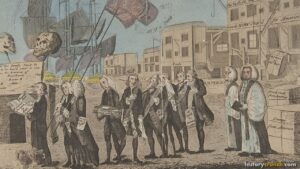
Loyalists were among the most important and often overlooked groups in the story of the American Revolution, because they show that the fight for independence was not supported by everyone in the thirteen colonies. Loyalists were American colonists who chose to remain faithful to the British Crown during the war for independence, which lasted from 1775 to 1783. While the Patriots pushed for a break from Britain, the Loyalists believed the colonies should stay part of the British Empire, and this disagreement turned the Revolution into a bitter conflict fought not only against Britain but among neighbors.
A Loyalist was a colonist who opposed the movement toward independence and continued to recognize the authority of King George III and the British Parliament. Loyalists were also commonly called Tories, a term used by their Patriot opponents as an insult. In simple terms, Loyalists wanted the colonies to remain loyal British subjects rather than form a new and separate nation.
What Was the American Revolution?
The American Revolution was the political and military struggle through which the thirteen colonies broke free from British rule and created the United States of America. It grew out of more than a decade of rising tension between Britain and its colonies over issues such as taxation, trade, and the right of colonists to govern themselves. Many colonists came to believe that their basic rights as British subjects were being ignored by a distant government.
Open fighting began in April of 1775 at the battles of Lexington and Concord in Massachusetts. A little over a year later, on July 4th, 1776, the colonies formally declared their independence from Britain. The war that followed lasted until 1783, when Britain finally recognized the United States as a free and independent nation. You can read more in the Causes of the American Revolution article.
What is sometimes forgotten is that the colonists were deeply divided over independence. As stated above, the Patriots supported the break from Britain, but a large number of colonists disagreed. These Loyalists believed that remaining part of the British Empire was safer, more lawful, and more sensible than a risky war against the most powerful military in the world.
Who Were the Loyalists?
Historians estimate that Loyalists made up roughly one-fifth of the colonial population, though exact numbers are hard to know because loyalty was often kept quiet. In fact, many colonists tried to avoid taking sides at all, hoping to stay out of a dangerous quarrel. This meant the colonies were roughly split among Patriots, Loyalists, and a large group of undecided people caught in the middle.
Loyalists came from every part of colonial society, which made them a very diverse group. They included wealthy merchants, royal officials, and Anglican clergymen, but also farmers, craftsmen, and recent immigrants. More specifically, groups such as Scottish immigrants, some Quakers, many Native American nations, and a number of enslaved and free African Americans sided with the British for reasons of their own.
Loyalists were often found in certain regions more than others. They tended to be strongest in and around cities such as New York, which the British held for much of the war, and in parts of the southern colonies. In reality, Loyalist strength shifted throughout the conflict, and the areas a person lived in could shape whether it was safe to speak openly about supporting the king.
Why Did Loyalists Support Britain?
Loyalists had many different reasons for remaining faithful to the Crown. For some, the ties were emotional and personal, since they thought of Britain as the mother country and viewed the king as their rightful ruler. Others valued order and stability, and they feared that rebellion would lead to mob violence and chaos rather than freedom.
Economic reasons also mattered a great deal. Merchants and landowners who traded heavily with Britain worried that independence would ruin their businesses and cut them off from valuable markets. In addition, royal officials, judges, and government workers owed their jobs and status to British rule, so a break with Britain threatened everything they had.
Some groups sided with Britain out of self-interest or a hope for protection. For instance, many Native American nations believed that Britain was more likely than the Patriots to limit colonial settlers from taking their lands. Likewise, thousands of enslaved African Americans fled to British lines after the British promised freedom in return for service, seeking liberty rather than loyalty to the king himself.
How Were Loyalists Treated During the War?
Loyalists faced harsh treatment from Patriots, who often viewed them as traitors to the American cause. Many Loyalists suffered public insults, threats, and violence, and some were tarred and feathered, a painful and humiliating punishment. Others had their property seized or were forced from their homes because of their political views.
Local Patriot committees kept watch over suspected Loyalists and pressured them to support the Revolution. In reality, this meant that even remaining silent could be dangerous, since neighbors were expected to prove their loyalty to the Patriot side. As a result, the Revolution took on the character of a civil war in many communities, dividing towns, churches, and even families.
Many Loyalists did not stay quiet. Tens of thousands of Loyalist men joined the British forces or served in Loyalist military units, fighting alongside British soldiers against their Patriot neighbors. This armed participation made the conflict especially bitter in regions such as the Carolinas, where Loyalist and Patriot forces clashed directly in brutal fighting.
What Happened to Loyalists After the Revolution?
The defeat of Britain in 1783 left Loyalists in a difficult and often frightening position. The war formally ended with the Treaty of Paris, signed on September 3rd, 1783, which recognized the United States as an independent nation. The treaty recommended that the individual states return property that had been taken from Loyalists, but the states were not required to do so and largely ignored the promise.
Because of this, tens of thousands of Loyalists chose to leave the new United States rather than live under a government they had opposed. Many feared continued mistreatment, loss of property, and the anger of their Patriot neighbors. Estimates suggest that somewhere between 60,000 and 70,000 Loyalists left the country in the years surrounding the end of the war.
Most of these refugees traveled to other parts of the British Empire. In fact, large numbers settled in what is now Canada, especially in Nova Scotia, New Brunswick, and Quebec, where they helped shape the future of those regions. Others sailed to Great Britain or to British colonies in the Caribbean, and among them were thousands of free Black Loyalists who had gained their freedom by supporting the British.
Life in exile was often hard. Many Loyalists arrived in unfamiliar lands with little money and struggled to rebuild their lives far from the homes they had known. Some eventually returned to the United States once tensions had cooled, but many never came back at all.
Significance of Loyalists in the American Revolution
The Loyalists are significant because they reveal that the American Revolution was far more complicated than a simple united fight against Britain. Their existence shows that many colonists genuinely believed remaining British was the wiser and safer choice, and that independence was a deeply divisive idea rather than an obvious one. Understanding the Loyalists helps explain why the Revolution felt like a civil war to so many of the people who lived through it.
The Loyalists also left a lasting mark far beyond the United States. Their migration northward strengthened British Canada and helped build its early population, culture, and government. In this way, the Loyalists shaped not only the story of the American Revolution but the history of an entire neighboring nation.
Finally, the treatment of the Loyalists raised difficult questions about freedom and tolerance in the new republic. A nation founded on ideas of liberty had punished and driven out citizens simply for holding different political beliefs. These events remind readers that the birth of the United States was a messy and painful process that carried real costs for many of the people involved.
Frequently Asked Questions
Why were Loyalists called Tories?
Loyalists were called Tories because Patriots borrowed the term from British politics, where it referred to those who supported the king and royal power. The Patriots used the word as an insult to suggest that Loyalists were enemies of American liberty. Loyalists in turn sometimes called the Patriots “rebels” or “Whigs” in response.
What percentage of colonists were Loyalists?
Historians estimate that about one-fifth, or roughly 20 percent, of the colonial population were Loyalists. However, these numbers are only estimates because many people hid their true feelings to stay safe. A large share of colonists also remained neutral, refusing to firmly commit to either side.
Where did Loyalists go after the American Revolution?
Most Loyalists who left the United States moved to other British territories, especially Canada. Regions such as Nova Scotia, New Brunswick, and Quebec received large numbers of these refugees. Smaller groups settled in Great Britain or in British colonies in the Caribbean.
Did any enslaved people become Loyalists?
Yes, thousands of enslaved African Americans escaped to the British side after the British promised freedom in exchange for their service. These men and women are often known as Black Loyalists, and many later resettled in Canada or elsewhere in the British Empire. For them, siding with Britain was a path to liberty rather than a matter of loyalty to the king.
Were Loyalists and Patriots the same as loyal and rebel colonists?
Loyalists were the colonists who stayed loyal to Britain, while Patriots were the colonists who supported independence. These were the two main opposing sides among the colonists themselves during the Revolution. A third large group stayed neutral and tried to avoid choosing a side entirely.
Cite This Article
To cite this article as a source, use one of the formats below.
MLA: Millar, B. “Loyalists in the American Revolution: A Detailed Summary.” HistoryCrunch, 10 August 2026, https://historycrunch.com/loyalists-in-the-american-revolution/.
APA: Millar, B. (2026). Loyalists in the American Revolution: A Detailed Summary. HistoryCrunch. https://historycrunch.com/loyalists-in-the-american-revolution/
Chicago: Millar, B. “Loyalists in the American Revolution: A Detailed Summary.” HistoryCrunch. August 10, 2026. https://historycrunch.com/loyalists-in-the-american-revolution/
Sources
- Gordon S. Wood, The Radicalism of the American Revolution.
- Yale Avalon Project