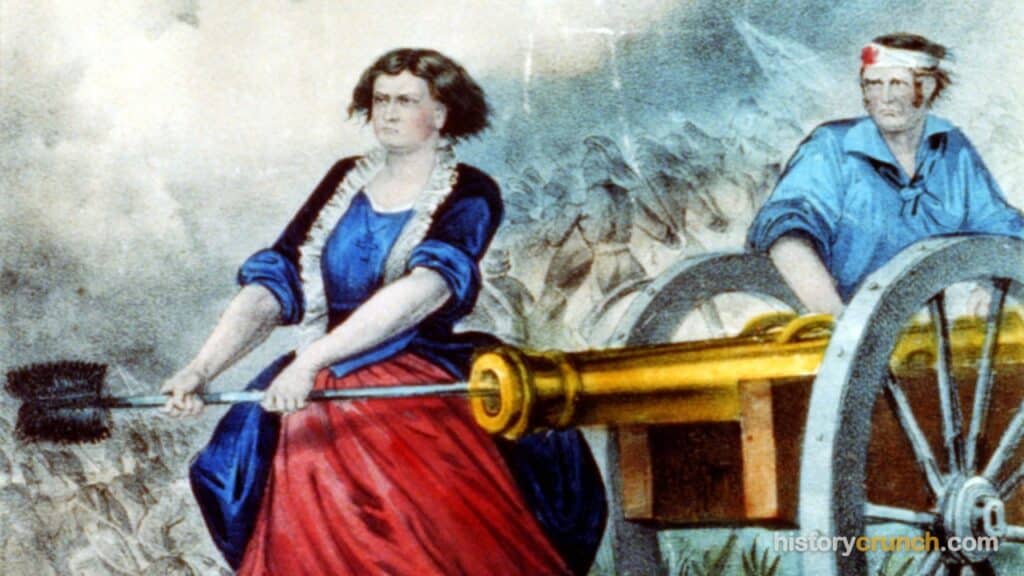
Molly Pitcher is one of the most famous figures connected to the American Revolutionary War, remembered as a symbol of the courage and hard work that women brought to the fight for American independence. The name refers to a heroine who carried water to soldiers during the heat of battle and then stepped in to help fire a cannon after a soldier was struck down. Most historians link the legend to a real woman named Mary Ludwig Hays, who followed her husband to war and took part in the Battle of Monmouth in 1778.
In simple terms, “Molly Pitcher” was a nickname rather than a person’s actual name. During the Revolutionary War, many women traveled with the Continental Army and carried pitchers of water to cool the cannons and to give thirsty men a drink. Over time, stories about several of these women blended together into a single heroic character called Molly Pitcher. In reality, the legend is best understood as both a real person, most likely Mary Ludwig Hays, and a symbol standing in for the thousands of women who supported the army.
Early Life and Background
The woman most closely tied to the Molly Pitcher story was Mary Ludwig, who was born on October 13th, 1754. Records place her birth near Trenton, New Jersey, though some accounts suggest she may have been born in Pennsylvania. She came from a family of modest means, and like most girls of her time, she received little if any formal schooling.
As a teenager, Mary went to work as a servant, a common path for young women from working families in colonial America. She eventually settled in Carlisle, Pennsylvania, where she found employment in a household and helped with cooking, cleaning, and other daily chores. This early life of steady labor prepared her for the demanding work she would later perform in an army camp.
While living in Carlisle, Mary met and married a barber named William Hays. In fact, this marriage would shape the rest of her life, because when the Revolutionary War began, William chose to join the fighting. His decision to enlist pulled Mary directly into the events of the war and eventually placed her on one of its most famous battlefields.
Life as a Camp Follower
When war with Great Britain broke out, William Hays enlisted in a company of Pennsylvania artillery, which later became part of the 4th Continental Artillery in George Washington‘s main army. As a gunner, he served on a cannon crew, a difficult and dangerous job in eighteenth-century warfare. His service meant long stretches away from home, so Mary made the choice to travel with him.
Women who traveled with the army in this way were known as camp followers. More specifically, these women were often the wives of soldiers who had no children at home and few ways to support themselves once their husbands marched away. They followed the troops from camp to camp and earned their keep through steady, essential labor.
The daily work of a camp follower was hard and constant. Women like Mary washed clothes, cooked meals, and cared for soldiers who were sick or wounded. To do these jobs, they carried water in pitchers from nearby springs and streams, and that same water was used on the battlefield to cool overheated cannons and to give exhausted men a drink. This tireless carrying of water is often given as the origin of the nickname “Molly Pitcher.”
Mary shared the hardships of army life alongside her husband, including the famous winter encampment at Valley Forge. As stated above, camp followers endured the same cold, hunger, and disease that plagued the soldiers. Their presence gave comfort to the men and helped keep the army running through its worst days.
The Battle of Monmouth
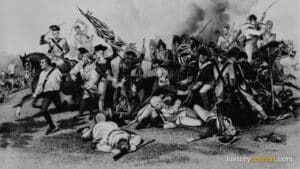
The event that made Molly Pitcher legendary took place on June 28th, 1778, at the Battle of Monmouth in New Jersey. The battle was fought after the British army left Philadelphia and began marching north toward New York City. General George Washington ordered his troops to strike at the retreating British column, which led to a fierce and confusing day of fighting.
The day of the battle was brutally hot, with temperatures reported to have climbed close to 100 degrees Fahrenheit (38 degrees Celsius). In such extreme heat, the water Mary carried became a matter of life and death. She was seen running back and forth from a spring, bringing pitcher after pitcher of cool water to soldiers who were fainting from thirst and exhaustion.
According to the well-known story, at some point during the battle William Hays collapsed, either from the heat or from a wound, as he worked at his cannon. Rather than flee, Mary is said to have taken his place at the gun and helped load and fire it for the rest of the fighting. This act of stepping directly into a soldier’s role during combat is the heart of the Molly Pitcher legend.
One dramatic detail from the day comes from a soldier who claimed to have watched a woman working a cannon when a British shot passed between her legs and tore away part of her skirt. In reality, she reportedly looked at the near miss with calm and simply went back to her work. Whether every detail is exactly true or not, such stories helped turn Mary’s bravery into a lasting national tale.
Recognition and Later Life
According to popular accounts, George Washington himself learned of the brave woman working with the artillery crew and wanted to honor her. The story holds that he thanked her personally and gave her the honorary rank of a noncommissioned officer, after which she was known as “Sergeant Molly.” Whether this exact event happened cannot be proven, but it became a beloved part of her story.
After the war, Mary returned to Carlisle, Pennsylvania. William Hays died around 1789, and Mary later married a man named John McCauley, becoming known as Mary Hays McCauley. She continued to work hard for the rest of her life, taking on jobs such as cleaning and caring for others in the community.
In her later years, Mary received official recognition for her wartime service. On February 21st, 1822, the state of Pennsylvania granted her an annual payment of $40 in return for services she had rendered during the Revolution. The wording of the grant did not spell out exactly what she had done, but it strongly suggested that she had played some real role in the war effort. Mary died on January 22nd, 1832, and was buried in the Old Graveyard in Carlisle.
Fact and Legend
Historians have long debated how much of the Molly Pitcher story is fact and how much is legend. Many now believe that Molly Pitcher is best understood as a composite figure, meaning a single character created out of the stories of several different women. In this view, the name came to stand for all the women who carried water and helped the troops during the Revolution.
Another woman often linked to the legend is Margaret Corbin, who took up a cannon after her husband was killed while defending Fort Washington in New York in 1776. Corbin was badly wounded in that fight and was sometimes called “Captain Molly,” which added to the confusion between the two women. Because their stories are so similar, the deeds of different women became mixed together over the years.
It is worth noting that the specific nickname “Molly Pitcher” did not become firmly attached to a single person until the mid-nineteenth century. In fact, it was around 1876, the hundredth anniversary of American independence, that the citizens of Carlisle publicly identified Mary Hays as the true heroine of Monmouth and honored her grave. This shows how the legend grew and took shape long after the events themselves.
Significance of Molly Pitcher
The significance of Molly Pitcher lies in what she represents about women and the American Revolution. For a long time, the story of the war focused almost entirely on generals and male soldiers. The Molly Pitcher legend reminds people that women were present in army camps and even on the battlefield, doing dangerous and vital work.
As a symbol, Molly Pitcher stands for the many thousands of women whose names were never recorded but who cooked, cleaned, nursed the wounded, and carried water under fire. Their labor kept the Continental Army alive during its hardest moments. By honoring one heroic figure, later generations found a way to honor all of these forgotten women at once.
Today, Molly Pitcher is remembered through monuments, artwork, and stories taught in schools across the United States. A statue and a cannon stand over Mary Hays’s grave in Carlisle, and another monument at the Monmouth battlefield honors her deed. In this way, a humble camp follower became one of the most enduring symbols of courage and patriotism in American history.
Frequently Asked Questions
Was Molly Pitcher a real person?
Molly Pitcher was likely based on a real woman, most often identified as Mary Ludwig Hays, but the name itself was a nickname rather than a real name. Many historians believe the full legend blends the deeds of several women into one heroic character. This makes Molly Pitcher both a real person and a symbol at the same time.
Why was she called Molly Pitcher?
The nickname most likely came from the pitchers of water she carried to soldiers and cannons during battle. “Molly” was a common, friendly nickname for women named Mary at the time. Soldiers may have called out for “Molly” and her water pitcher when they needed a drink or needed to cool a hot gun.
What did Molly Pitcher do at the Battle of Monmouth?
At the Battle of Monmouth in 1778, she carried water to overheated soldiers on an extremely hot day and then helped work a cannon after her husband went down. The battle was fought as the British marched from Philadelphia toward New York. Her actions that day are what turned her into a national legend.
Was Molly Pitcher the same person as Margaret Corbin?
No, Margaret Corbin was a different real woman, though her story is often mixed with the Molly Pitcher legend. Corbin took up a cannon after her husband was killed at Fort Washington in 1776 and was seriously wounded. Because she was also nicknamed “Captain Molly,” people sometimes confused the two heroines over the years.
How is Molly Pitcher remembered today?
Molly Pitcher is remembered through statues, monuments, paintings, and lessons in history classes. A monument and cannon mark Mary Hays’s grave in Carlisle, Pennsylvania, and a memorial stands at the Monmouth battlefield. The United States Army even created an award called the Order of Molly Pitcher to honor those who support military families.
Cite This Article
To cite this article as a source, use one of the formats below.
MLA: Millar, B. “Molly Pitcher: A Detailed Biography.” HistoryCrunch, 10 August 2026, https://historycrunch.com/molly-pitcher/.
APA: Millar, B. (2026). Molly Pitcher: A Detailed Biography. HistoryCrunch. https://historycrunch.com/molly-pitcher/
Chicago: Millar, B. “Molly Pitcher: A Detailed Biography.” HistoryCrunch. August 10, 2026. https://historycrunch.com/molly-pitcher/
Sources
- Jerry Bentley & Herbert Ziegler, Traditions & Encounters: A Global Perspective on the Past.
- J.M. Roberts & Odd Arne Westad, The Penguin History of the World.