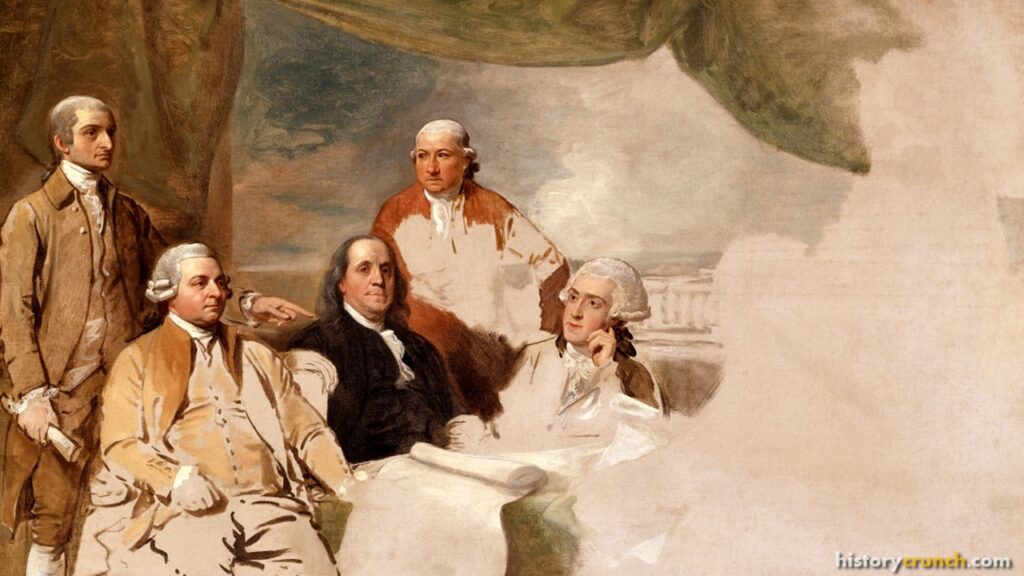
The Treaty of Paris was a peace agreement signed on September 3, 1783, between the United States and Great Britain that formally ended the American Revolutionary War. The treaty recognized the United States as a free and independent nation for the first time, established the boundaries of the new country, and settled several outstanding disputes between the two sides. Negotiated over more than a year in Paris by a skilled team of American diplomats, the treaty secured terms far more favorable to the United States than many had expected, and set the stage for the remarkable growth of the new nation in the decades that followed.
What Was the American Revolution?
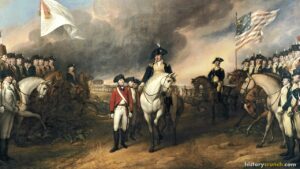
The American Revolution was the political and military struggle through which the Thirteen Colonies broke free from British rule and established the United States of America. Tensions between the colonies and Britain had been building since the early 1760s over issues of taxation, trade, and self-government. Open fighting began in April of 1775 at Lexington and Concord, and the colonies formally declared independence on July 4th, 1776. The war lasted eight years and drew in France, Spain, and the Dutch Republic as allies of the American cause. The decisive turning point came in October of 1781, when British General Cornwallis surrendered to American and French forces at Yorktown, Virginia. The Treaty of Paris was the formal conclusion of that struggle, translating the military victory into a permanent legal and diplomatic reality.
Background – The Road to Negotiations
When news of the British defeat at Yorktown reached London, Prime Minister Lord Frederick North reportedly collapsed in shock. Support in Parliament for continuing the war collapsed alongside him. North resigned in March of 1782, and his successor, Lord Shelburne, moved quickly to begin peace talks. Shelburne saw American independence not as a defeat but as an economic opportunity. He believed that a generous peace settlement would make the United States a valuable trading partner for Britain, producing benefits that would far outweigh the loss of the colonies. This thinking shaped the British approach and helps explain why the final terms were so favorable to the American side.
Formal peace talks opened in Paris in April of 1782, beginning as informal discussions between the British representative Richard Oswald and Benjamin Franklin, who had been serving as American ambassador to France. The full American negotiating team soon assembled in the city.
The American Negotiators
The United States was represented by three of the most capable diplomats of the era. Benjamin Franklin was the senior American figure in Paris, with years of experience dealing with European governments and a key role in securing the French alliance. John Adams had successfully negotiated a treaty of friendship and a loan with the Dutch Republic in 1782. John Jay brought a sharp legal mind and deep suspicion of European motives. Henry Laurens, a former president of the Continental Congress who had been captured by the British and imprisoned in the Tower of London, joined the negotiations two days before the preliminary articles were signed.
Despite being relative newcomers to the world stage, these men consistently held their own against far more experienced European diplomats.
Complications with France and Spain
The negotiations were complicated by the involvement of France and Spain. Under the terms of the 1778 Franco-American alliance, the United States was obligated to consult France before concluding any separate peace with Britain. France, in turn, was bound by its alliance with Spain, and Spain was still hoping to capture Gibraltar from the British. This created a deadlock.
French Foreign Minister Vergennes proposed terms that would have been far less favorable to the Americans, confining the new nation to the territory east of the Appalachian Mountains and leaving vast western lands to Britain and Spain. The American negotiators rejected this entirely. John Jay in particular was deeply suspicious of French intentions. He persuaded the others to bypass France and negotiate directly with the British, which Lord Shelburne eagerly agreed to. Vergennes was frustrated when he found out, but accepted the outcome. The Americans had already secured a deal that could not be undone.
The Preliminary Articles and Final Signing
Two months of direct negotiations produced a set of preliminary articles of peace, signed on November 30th, 1782. These settled the most important questions, including the boundary of the new nation and the recognition of American independence. France signed its own preliminary articles with Britain on January 20th, 1783.
The terms drew heavy criticism in Britain. Lord Shelburne’s government was attacked in Parliament for being too generous, and he resigned in February of 1783. His replacement sent a new British representative, David Hartley, to Paris to see if the terms could be revised. The Americans refused.
The final Treaty of Paris was signed on September 3rd, 1783, at the Hotel d’York on the Rue Jacob in Paris. Franklin, Adams, and Jay signed for the United States. David Hartley signed on behalf of King George III. On the same day, Britain signed separate peace treaties with France and Spain, collectively known as the Peace of Paris. The Continental Congress ratified the Treaty of Paris on January 14th, 1784.
Key Terms of the Treaty
The Treaty of Paris was written in ten articles and covered several key areas.
Recognition of Independence – The first and most important article formally acknowledged the United States as free, sovereign, and independent states. Britain renounced all claims to their government, their territory, and their people. This recognition was unambiguous and unconditional, and Article 1 of the Treaty of Paris remains in force to this day.
Boundaries of the United States – The treaty defined the boundaries of the new nation in generous terms. The northern boundary ran along the Great Lakes and the present-day border with Canada. The southern boundary was set at the northern edge of Florida. The eastern boundary was the Atlantic Ocean. Most significantly, the western boundary was set at the Mississippi River, effectively doubling the size of the United States compared to the territory of the original thirteen colonies. This western land grant opened up enormous potential for expansion and was the single most valuable territorial gain of the treaty.
Fishing Rights – The treaty guaranteed American fishermen the right to fish in the waters off Newfoundland and in the Gulf of St. Lawrence, including on the Grand Banks. These were some of the richest fishing grounds in the world and were vital to the economies of New England and the maritime colonies.
Navigation of the Mississippi River – Both the United States and Great Britain were granted the right to navigate the Mississippi River freely. This was important for American settlers and traders in the western territories.
Debts. -The treaty called on both sides to honor pre-war debts owed to creditors in the other country. American debtors were expected to pay what they owed to British merchants, and British debtors were expected to do the same. In practice, collecting these debts proved very difficult in the years that followed.
Treatment of Loyalists – The treaty included provisions calling on the United States to recommend to the individual states that they restore property confiscated from Loyalists during the war and to stop persecuting those who had sided with Britain. This was one of the most controversial provisions in Britain, where many expected a stronger protection of Loyalist rights. In practice, the individual states largely ignored these recommendations, and most Loyalists who filed for compensation received nothing. Britain ultimately used tax revenue to compensate many of its loyal subjects out of its own treasury.
Withdrawal of British Forces – Britain agreed to withdraw its military forces from American territory promptly. In practice, this took longer than expected. British troops did not evacuate New York City until November of 1783, and British forts in the northwestern territories were not relinquished until years later, a source of ongoing tension between the two nations.
Significance of the Treaty of Paris in 1783
The Treaty of Paris of 1783 was one of the most important diplomatic achievements in American history. It transformed the United States from a rebel movement into a recognized nation with defined borders, established rights, and a legitimate place among the nations of the world. The vast western territory it secured provided the land base for a century of westward expansion and population growth.
The skill with which Franklin, Adams, and Jay navigated the competing interests of Britain, France, and Spain to secure favorable terms was a remarkable achievement. Some tensions with Britain lingered for years over unresolved issues such as British forts in the northwest and unpaid debts, but the peace made in Paris laid the foundation on which the two nations would eventually build one of the most important relationships in the modern world.