The Intolerable Acts were a series of laws passed by the British Parliament in 1774 in direct response to the Boston Tea Party of December of 1773. Known in Britain as the Coercive Acts, they were called intolerable by American colonists because of how harsh and punishing they were. The laws were aimed primarily at Massachusetts, intended to punish the colony and restore British authority there. Instead, they had the opposite effect, uniting the thirteen colonies in opposition to Britain and directly leading to the First Continental Congress.
What Was the American Revolution?
The American Revolution was the political and military struggle through which the Thirteen Colonies broke free from British rule and established the United States of America. By 1774, tension between Britain and the colonies had been building for more than a decade over questions of taxation and self-government. The Intolerable Acts were the final major escalation before the shooting started. Rather than breaking colonial resistance, they transformed scattered protests into a coordinated revolutionary movement. Within a year of their passage, fighting had broken out at Lexington and Concord.
Background – The Boston Tea Party
The immediate cause of the Intolerable Acts was the Boston Tea Party of December 16th, 1773. Colonists, organized largely by the Sons of Liberty, boarded ships in Boston Harbor and dumped 342 chests of British East India Company tea into the water to protest the Tea Act, which had given the company a monopoly over the colonial tea trade. The destruction of private property worth thousands of pounds outraged members of Parliament, who felt the time for patience had passed. Prime Minister Lord North argued that Parliament had to take a firm stand or risk losing control of the colonies entirely.
The Four Acts
Parliament passed four laws in the spring and summer of 1774 that together formed the core of what colonists called the Intolerable Acts.
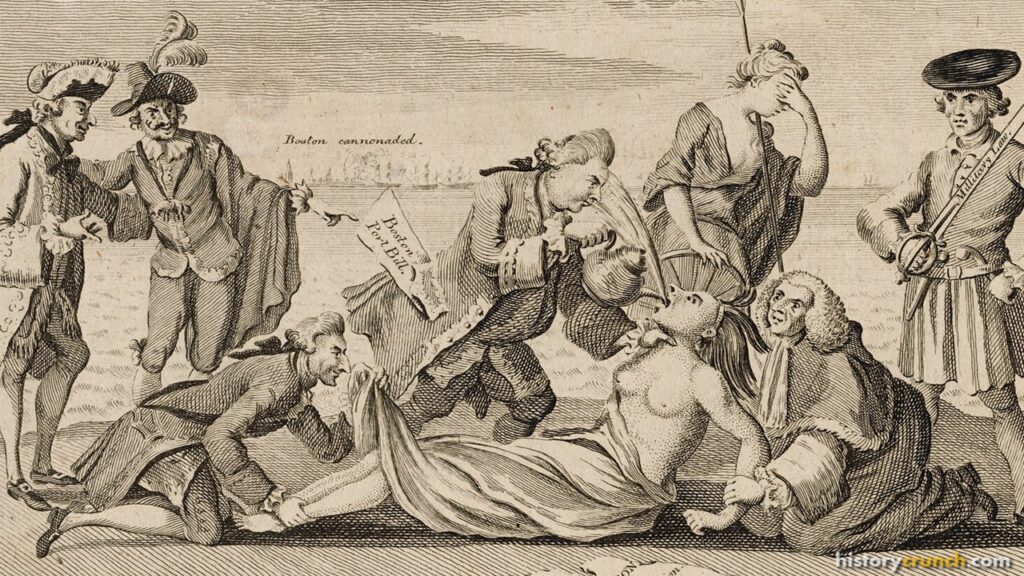
The Boston Port Act, passed on March 31st, 1774, was the most immediately devastating. It closed the port of Boston to all trade until the colonists paid for the destroyed tea and the British government was compensated for lost customs revenue. Closing the port cut off Boston’s economy entirely, preventing the delivery of food, supplies, and goods into the city.
The Massachusetts Government Act, passed on May 20th, 1774, went much further than punishing Boston. It effectively ended self-government in Massachusetts. The act replaced the elected council with one appointed by the Crown, gave the British-appointed governor sweeping new powers, and restricted town meetings to one per year without prior approval from the governor. In a colony where town meetings had been the foundation of local democracy for generations, this was seen as a direct attack on the way of life that colonists had known for over a century.
The Administration of Justice Act, passed on May 20th, 1774, allowed British officials charged with crimes in Massachusetts to be tried in another colony or in Britain rather than in local courts. Colonists believed this would effectively let British soldiers and officers act without accountability, since a jury in Britain would be far less likely to convict them.
The Quartering Act, passed on June 2nd, 1774, applied to all of British America and required colonial authorities to provide housing for British troops in unoccupied buildings. It revived the anger that had surrounded the earlier Quartering Act of 1765, which had been allowed to expire in 1770. In Massachusetts, the presence of troops was already a source of tension, and the new law was seen as an attempt to maintain an armed occupation of the colony.
The Quebec Act
A fifth law, the Quebec Act, was passed in the same legislative session and is often grouped with the Intolerable Acts, though it was not specifically aimed at punishing Massachusetts. It extended the territory of Quebec southward to the Ohio River, cutting off land claims that several colonies had to the western frontier, and granted the French Catholic majority of Quebec the right to practice their religion freely and maintain French civil law. Protestant colonists were alarmed by the religious provisions, and the expansion of Quebec territory was seen as a direct threat to colonial western expansion.
Colonial Response
The Intolerable Acts backfired badly for Britain. Rather than isolating Massachusetts and forcing it to submit, the laws alarmed colonists across all thirteen colonies, who recognized that if Parliament could strip Massachusetts of its self-government, it could do the same to any of them. Days of prayer and fasting were held throughout the colonies in solidarity with Boston. Food and supplies were sent overland to help the people of Boston through the port closure. The Virginia House of Burgesses was dissolved by its royal governor after expressing support for Massachusetts, which only spread the sense of outrage further.
The Committees of Correspondence, already active across the colonies, coordinated the response. Colonial leaders in Virginia and New York called for an intercolonial meeting, which resulted in the First Continental Congress meeting in Philadelphia in September of 1774. Twelve colonies sent delegates, and the Congress produced a Declaration of Rights, a boycott agreement, and a petition to the king. Parliament, unlike during the Stamp Act crisis, did not repeal the Intolerable Acts. By April of 1775, armed conflict had begun.
Significance of the Intolerable Acts
The Intolerable Acts are widely regarded as one of the most important causes of the American Revolution. Britain intended them to make an example of Massachusetts and restore order across the colonies. In reality, they did the opposite. They gave the colonies a common cause to rally around, produced the first truly unified colonial political body in the First Continental Congress, and convinced many colonists who had previously hoped for reconciliation that Britain would not treat them fairly. As one British member of Parliament, Edmund Burke, had warned, the harsh measures only awakened a fiercer spirit of resistance. The Intolerable Acts set the two sides on a path that ended in war.