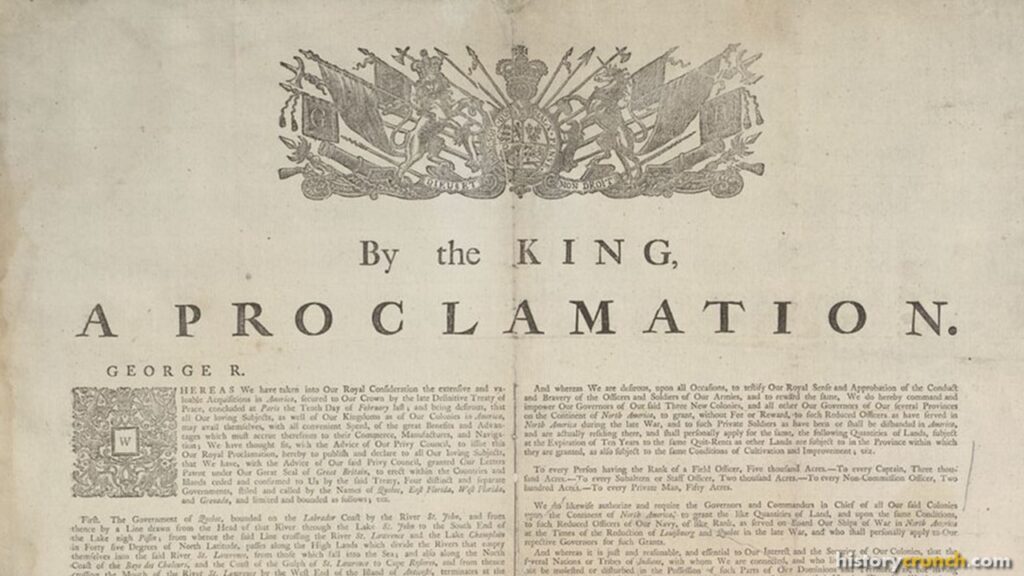
The Proclamation of 1763 was a royal decree issued by King George III of Great Britain on October 7, 1763, that prohibited British colonists from settling west of the Appalachian Mountains. Issued in the immediate aftermath of the French and Indian War, the proclamation was intended to prevent further conflict with Native American nations by establishing a clear boundary between colonial settlement and Indigenous territory. Instead, it angered colonists, frustrated land speculators, and became one of the earliest sources of tension between Britain and its American colonies in the years leading up to the American Revolution.
What Was the American Revolution?
The American Revolution was the political and military struggle through which the Thirteen Colonies broke free from British rule and established the United States of America. The conflict grew out of more than a decade of escalating disputes over taxation, self-government, and colonial rights. The Proclamation of 1763 was one of the very first of those disputes. It was the first law passed by the British government that affected all thirteen colonies simultaneously, and it introduced colonists to the idea that Britain intended to exercise much tighter control over their lives than it had in the previous century. In this way, the Proclamation of 1763 is often considered the opening act in the series of events that led to the Revolution.
Background – The French and Indian War
The Proclamation grew directly out of the outcome of the events of the French and Indian War, the North American theater of the global Seven Years’ War that ended in 1763. Britain’s victory over France was enormous in its territorial scope. Under the Treaty of Paris of 1763, France ceded all of its territory east of the Mississippi River to Britain, essentially giving the British Empire control over the entire eastern half of North America. Colonists were excited by the prospect of settling these vast new lands west of the Appalachian Mountains, which had previously been blocked by French claims and the conflicts that came with them.
That excitement ran almost immediately into violence. Most Native American nations in the Ohio Valley and Great Lakes region had been allied with the French during the war, and they were deeply alarmed by the sudden arrival of British control and the rapid movement of settlers onto their lands. In May of 1763, a pan-tribal coalition led by Ottawa chief Pontiac launched a coordinated uprising now known as Pontiac’s Rebellion. Warriors attacked and captured eight British forts and raided numerous frontier settlements, killing hundreds of soldiers and settlers. The rebellion exposed how fragile British control over the new western territories was and how costly continued conflict with Native nations could become.
What the Proclamation Said
Faced with the escalating crisis of Pontiac’s Rebellion and the enormous expense of managing a vast new empire, the British government moved quickly to establish order. The Proclamation of 1763, issued on October 7, drew a line along the crest of the Appalachian Mountains from Georgia to Quebec and declared all land west of that line to be reserved for Native American nations. Colonists were forbidden from settling there, and those who had already moved west were ordered to return east of the line.
The proclamation also prohibited private individuals and colonial governments from purchasing land directly from Native peoples. Any future land acquisitions west of the line could only be conducted by the British Crown through formal, publicly announced treaties. Only licensed traders would be permitted to cross the line at all. Britain justified these measures as necessary to prevent fraud, protect Native peoples from exploitation, and avoid the kind of violence that had just erupted with Pontiac’s Rebellion. To enforce the boundary, Britain planned to station 10,000 troops along the frontier, at an annual cost of roughly 250,000 pounds, a bill it expected the colonies to help pay.
The proclamation also organized the new territories Britain had acquired from France and Spain. It formally created the provinces of Quebec, East Florida, and West Florida, giving them governments and legal frameworks.
Colonial Reaction
The colonial reaction to the Proclamation of 1763 was swift and largely negative. For ordinary settlers looking to farm new land, the proclamation closed off territory they had believed was now open to them after years of fighting. For wealthy land speculators, including prominent figures such as George Washington, Patrick Henry, and Henry Laurens, the proclamation threatened investments and plans that had been in development for years. Washington was particularly blunt in his private correspondence, writing that the proclamation was only ever intended as “a temporary expedient to quiet the minds of the Indians” and openly advising his agent to buy as much Native land as possible before the boundary was eventually pushed further west.
Many colonists also resented the proclamation for a deeper reason. Britain was telling them where they could and could not live on land they regarded as rightfully theirs, and doing so without the input or consent of their own elected assemblies. The decision was made entirely in London, with no colonial representation involved. For people who had spent the previous decade developing a strong sense of self-governance, that was a serious grievance.
In practice, enforcement of the proclamation was weak. Settlers crossed the Appalachians in large numbers almost immediately, and British troops rarely had the strength or the will to remove them. On a few occasions, soldiers at frontier forts did burn the cabins of settlers and escort them back across the line, but such enforcement was the exception rather than the rule. The proclamation did not stop westward movement. It only made that movement illegal.
Effects on Native Americans
For Native American nations west of the Appalachians, the Proclamation of 1763 offered a degree of protection that had not existed before. It was, in fact, the first time any European colonial power had formally recognized that Indigenous peoples had legal rights to their land that could not simply be taken away by private transactions. Pontiac’s Rebellion gradually wound down after the proclamation was issued, and formal peace was reached in 1766. Many Native leaders hoped the boundary would hold and that Britain would enforce it.
Those hopes were largely disappointed. Settlers ignored the line, and Britain lacked both the resources and the political will to stop them. As colonial resistance to British authority grew through the late 1760s and 1770s, the proclamation’s promises to Native nations became increasingly empty. When the American Revolution removed British authority from the eastern colonies altogether, the proclamation line ceased to have any practical meaning, and the westward expansion that had been temporarily restrained surged forward with no legal barrier at all.
Significance of the Proclamation of 1763
The Proclamation of 1763 was an important early step in the deterioration of relations between Britain and its American colonies. It introduced colonists to a new reality: that Britain intended to govern their lives and limit their opportunities in ways they had not experienced before. By restricting westward expansion, imposing the costs of frontier defense on the colonies, and making decisions that affected every colony without consulting any colonial assembly, the proclamation pointed in exactly the direction that would lead to revolution.
It is also significant as a legal document. In Canada, the Royal Proclamation of 1763 remains a foundational text in Indigenous law, recognized in the Constitution Act of 1982 as an early statement of Aboriginal land rights and title. In the United States, the proclamation was effectively swept aside by westward expansion, but it stands as an early example of the conflict between settler ambitions and Indigenous rights that would define North American history for the following century.