The Battle of Bunker Hill was the first major engagement of the American Revolutionary War, fought on June 17th, 1775, on the Charlestown Peninsula north of Boston, Massachusetts. Though the British ultimately captured the American positions and won the battle, they suffered devastating casualties doing so. The engagement proved that colonial militiamen could stand and fight against professional British soldiers, transformed the mood of the conflict, and convinced both sides that the war ahead would be long and costly.
What Was the American Revolution?
The American Revolution was the political and military struggle through which the Thirteen Colonies broke free from British rule and established the United States of America. The first shots had been fired at Lexington and Concord just two months earlier, in April of 1775, and thousands of colonial militiamen had since surrounded Boston, trapping the British garrison there. The Battle of Bunker Hill grew directly out of that standoff. It was the first time the two sides faced each other in a large, organized engagement, and the result changed how both Britain and the colonies understood what this war was going to look like.
Background – The Siege of Boston
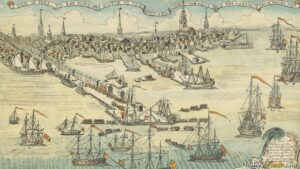
After the battles of Lexington and Concord, the British army retreated to Boston and found itself besieged. By June of 1775, roughly 15,000 to 20,000 colonial militiamen from Massachusetts, Connecticut, New Hampshire, and Rhode Island had assembled on the hills surrounding the city. The British garrison of around 6,000 soldiers under General Thomas Gage occupied Boston itself, able to be resupplied and reinforced by sea but unable to break out overland without a fight.
Both sides recognized that the hills around Boston were strategically critical. Whoever placed artillery on those heights could dominate the city and its harbor. Dorchester Heights to the south of Boston was one such position. The Charlestown Peninsula to the north, containing Bunker Hill and the lower Breed’s Hill, was another. In mid-June, colonial leaders learned that the British were planning to occupy and fortify these high ground positions. They decided to act first.
The American Occupation of Breed’s Hill
On the night of June 16th, 1775, a force of approximately 1,200 colonial soldiers under Colonel William Prescott marched silently onto the Charlestown Peninsula. Their orders were to fortify Bunker Hill, the higher of the two hills on the peninsula. For reasons that have never been fully explained, Prescott instead directed his men to begin constructing fortifications on Breed’s Hill, which sat lower and closer to Boston. Working through the night with picks and shovels, the men built a substantial earthen redoubt, a roughly square fortification with walls about six feet high, along with connecting trenches and breastworks extending toward the Mystic River.
When dawn broke on June 17th, British officers on ships in the harbor were astonished to see the overnight fortifications. British warships immediately began bombarding the American positions, though to little effect. General Gage and his officers, who now included recently arrived generals William Howe, Henry Clinton, and John Burgoyne, debated how to respond. Clinton argued for landing troops behind the Americans to cut off their retreat, which would have trapped them on the peninsula. Howe argued for a direct frontal assault on the American positions. Howe’s approach was chosen.
Major Events of the Battle of Bunker Hill
On the afternoon of June 17th, British forces crossed Boston Harbor by boat and landed on the Charlestown Peninsula. They numbered roughly 2,200 soldiers in their full attacking force, including elite grenadier and light infantry units. General Howe personally led the assault.
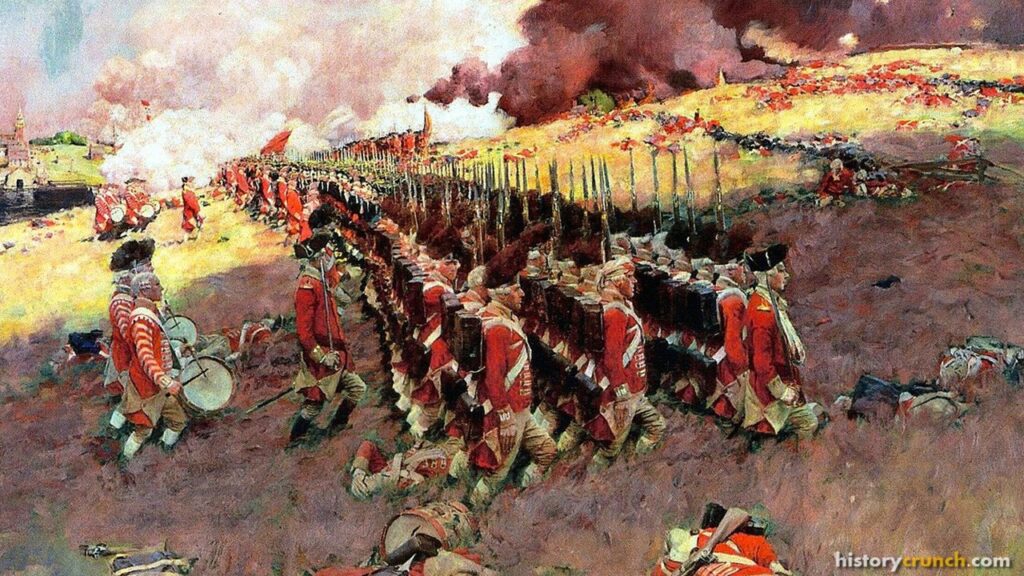
The attacking British soldiers advanced in orderly lines up the slopes toward the American positions, carrying full packs that weighed roughly 60 pounds each in the summer heat. The colonial defenders had a significant ammunition shortage, and their commanders gave strict instructions not to fire until the British were close enough that no shot would be wasted. The famous order associated with the battle, “Don’t fire until you see the whites of their eyes,” reflected the desperate need to make every round count.
When the British came within close range, the Americans opened fire with devastating effect. The first assault was repulsed with heavy British casualties. Officers fell in particularly large numbers because colonial marksmen deliberately targeted them, recognizing that killing officers stripped the British infantry of its leadership. Howe reorganized his men and launched a second assault. It too was driven back.
By this point the British had suffered enormous losses, particularly among their officers. But Howe pressed on. For the third assault, he adjusted his tactics, directing more of his force against the American left flank, which was less well defended than the redoubt. The Americans were also nearly out of ammunition. When the British reached the walls of the redoubt, desperate hand-to-hand fighting broke out. Without musket balls, many American defenders were fighting with their muskets as clubs. Prescott ordered a retreat. The Americans withdrew from Breed’s Hill in good order, falling back across the neck of the peninsula. The British held the position but were too battered to pursue aggressively.
One of the notable American casualties of the battle was General Joseph Warren, a physician and prominent Patriot leader who had entered the redoubt as a volunteer and was killed in the final moments of the fighting. He was one of the most prominent Americans to die in the entire Revolutionary War.
Casualties
The casualties of the Battle of Bunker Hill were remarkable in proportion to the forces engaged. The British suffered 1,054 killed and wounded, including 89 officers, out of roughly 2,200 engaged. This represented a casualty rate of nearly 50 percent, one of the highest of any British engagement in the war. American losses were approximately 450 killed, wounded, or captured. The loss of so many experienced British officers in a single engagement was a blow that took considerable time to recover from.
The Overall Context to the American Revolution
The Battle of Bunker Hill took place on June 17th, 1775, the day after the Continental Congress in Philadelphia had appointed George Washington as Commander-in-Chief of the Continental Army. Washington was still traveling to Boston when the battle was fought. He took formal command of the army on July 3rd, 1775, and spent the following months organizing and disciplining the force that had gathered around Boston. The battle had proved both the potential and the limitations of colonial militia. Washington recognized that turning this motivated but disorganized force into a professional army capable of fighting a prolonged war would be the central challenge of the coming years.
The British occupation of Charlestown was rendered ultimately useless when Washington had the cannon captured at Fort Ticonderoga dragged to Boston and placed on Dorchester Heights in March of 1776, forcing the British to evacuate the city entirely.
Significance of the Battle of Bunker Hill
The Battle of Bunker Hill had an impact far beyond its military outcome. Though the British technically won by taking the American positions, the cost shocked them deeply. General Howe, who led the assault and saw his men fall in appalling numbers, carried the memory of Bunker Hill with him throughout his command and became notably cautious about launching frontal attacks against fortified American positions in the years that followed.
For the Americans, the battle was a powerful demonstration that colonial militiamen could stand toe to toe with professional British soldiers and inflict enormous damage before giving ground. It silenced those who had believed the British would crush the rebellion quickly and easily. It gave the Patriot cause credibility and encouraged recruitment across the colonies. The knowledge that the war would be fought on roughly equal terms gave the revolutionary movement the confidence it needed to press forward, and the battle is today remembered as one of the defining moments of the American Revolution’s opening year.